
General election loss in 1945 meant Winston Churchill could write his history of Second World War
After the 1945 general election, Winston Churchill’s wife tried to comfort her husband, privately hurt by his rejection at the polls, by observing that ‘Perhaps it was a blessing in disguise’, to which he replied: ‘At the moment it seems quite effectively disguised.’
Churchill had suffered such rebuffs and setbacks before. For example, in 1922 he had famously lost his appendix, his parliamentary seat at Dundee and his membership of the Cabinet. And he was to be out of the Commons for two years.
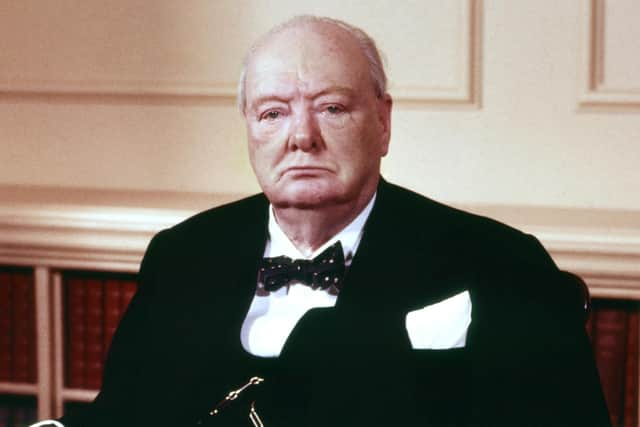

In 1945 he lost his job, his London home and perhaps even his reason for living. Yet there was wisdom in Mrs Churchill’s words.
The 70-year-old Churchill was physically exhausted after leading the country through the war and needed time to recuperate.
If he had won, he would have had to embark on the gruelling task of rebuilding a nation that had lost a quarter of its national wealth and had been devastated by war. This would not have been his forte.
Furthermore, he was now focused on international relations rather than domestic policy which was what was of paramount importance to the electorate. (Andrew Roberts shrewdly observes that Churchill in office could not have warned of the threat of Soviet Communism if he had to deal diplomatically with the USSR daily.)
Quite frankly, Churchill was not the man to ‘reinvent’ and modernise the Conservative Party. This was a task best left to R A Butler and his bright young protégés in the Conservative Research Department.
Above all, defeat gave him time to write. Although a politician, Churchill sustained his lifestyle through his writing. Given the burdens of office, his age and the state of his health, he could never have written ‘The Second World War’ – in six volumes and comprising over 4,200 pages – if he had won the 1945 general election.
The idea of ‘the verdict of history’ fascinated Churchill. One of his favourite quips, frequently recycled as the best quips always are, was ‘I shall leave it to history, but remember that I shall be one of the historians’.
Although widely regarded as a work of history, ‘The Second World War’ is essentially a memoir comparable to ‘The World Crisis’ which he wrote after the Great War. As he candidly explained to Bill Deakin, a young Oxford historian and one of his researchers, ‘This is not history, this is my case’.
All memoirs are self-serving and Churchill’s was no exception. He gave the impression that he was a consistent advocate for the D-Day landings whereas, haunted by the experience of Gallipoli, the truth was otherwise.
He glided over episodes – like the loss of the HMS Prince of Wales and HMS Repulse, the Dieppe raid and Arnhem – which did not suit the narrative. Churchill intended to be highly critical of the Dieppe raid but muted his criticism because Mountbatten was an influential man related to the royal family who would have probably sued for libel had the first draft been published.
The work was primarily directed at an Anglophone audience and the war was unashamedly viewed through an Anglo-American lens. El Alamein and D-Day merited greater weighting than Stalingrad and Bagration (despite their immense significance). Churchill deliberately underplayed the Red Army’s decisive contribution to victory. This was partially attributable to the onset of the Cold War. (In the chapter about Operation Barbarossa Churchill delivered a well-merited attack on the ‘error and vanity’ of Stalin for ignoring repeated British warnings that Hitler was going to invade the Soviet Union in the spring of 1941.)
He was circumspect in his treatment of Truman and Eisenhower (but only after he became aware of Eisenhower’s intention to run for the US presidency in 1952) and Tito (whom he viewed as ‘a viper’) and de Gaulle because he expected these figures to continue to be significant political players in the years ahead. Churchill deleted mention of his order in June 1944 that de Gaulle, who wanted to take part in the D-Day landings, should be ‘shipped to Algiers in chains if necessary. He must not be allowed to enter France’.
Churchill’s treatment of Air Chief Marshal Hugh Dowding, a shy, modest man who was disproportionately responsible for winning the Battle of Britain, was embarrassing.
Likewise, Field Marshal Alan Brooke, who served as Chief of the Imperial General Staff (CIGS) for most of the war and Churchill’s foremost military advisor, was barely mentioned except with respect to his command of II Corps in France in 1940 but not as CIGS.
The Official Secrets Act prevented Churchill from revealing the work of the Enigma code breakers at Bletchley Park or the development of the atom bomb.
Most political memoirs are written in retirement but Churchill regarded retirement as a ‘living death’. Having recovered his equilibrium, he was determined to claw his way back from defeat in 1945, to secure his reputation and to win a second term as prime minister – which he did in the general election of October 1951.
David Reynolds in his book entitled ‘In Command of History’ elaborates: ‘In May 1940 he had become Prime Minister not through election but because of a Commons revolt against Chamberlain. When he went to the people for a mandate in 1945, they gave him, it seemed, a resounding “no”. So Churchill kept going because of his nature but also, I think, in a search for vindication.’
Publication of ‘The Hinge of Fate’, the fourth volume of the magnum opus, in the United States in November 1950 prompted the New York Times to suggest that Churchill ought to be awarded the Nobel Prize for Literature and in 1953 he was. Initially, he was disappointed not to have won the Peace Prize.
Sigfrid Siwertz, the distinguished Swedish novelist who delivered the presentation speech, praised ‘My Early Life’, ‘Great Contemporaries’ and ‘Marlborough’ but failed to mention ‘The Second World War’. He concluded by observing: ‘Generally the Nobel Prize gives lustre to the prize-winner. In this case the prize-winner gives lustre to the prize.’
Was Siwertz implying that the prize was awarded not so much for his literary achievement but for his leadership in the struggle against Fascism between 1940 and 1945? Possibly.