
General George Patton was brash, bullish and aggressive and was loved by his troops
George Smith Patton, who commanded the Seventh United States Army in the Mediterranean theatre and the Third United States Army in France and Germany after D-Day, was the outstanding Allied exponent and practitioner of armoured warfare.
In 1944 and 1945 he demonstrated his mastery of this form of warfare by commanding large armoured formations and deploying them in mobile, high-speed operations.
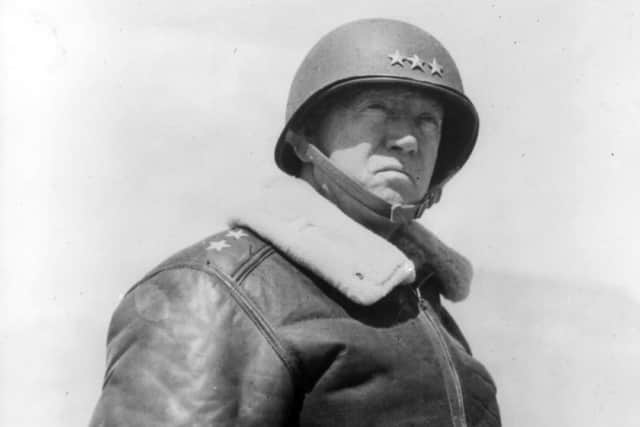

‘The only way you can win a war is to attack and keep attacking, and after you have done that, keep attacking some more’ was his military philosophy.
The German staff officer Günther Blumentritt regarded him with admiration as ‘the most aggressive panzer-general of the Allies’.
Patton’s emphasis on strict discipline, toughness, and self-sacrifice created exceptional pride within his ranks of his troops. They referred to him as ‘Old Blood-and-Guts’, a nickname derived from his observation in 1940 that ‘War will be won by Blood and Guts alone’.
As a soldier he was professional but his personal brashness and impulsiveness generated numerous controversies to the detriment of his career. For example, a moment of madness in Sicily in 1943, when he struck two private soldiers suffering from shell shock (a condition which he refused to recognise), cost him command of US ground forces on D-Day.
Colourful, even profane, language was a major feature of Patton’s motivational addresses to his troops before the invasion of Europe. Although these speeches were viewed as unprofessional by other officers, they went down extremely well with his troops.
In March 1944 he visited units based in Down and Armagh. (Eisenhower conducted a similar tour in Fermanagh.) Prior to his speech in The Mall in Armagh, military police moved civilians from the area. Officially for ‘security reasons’, the real reason was to prevent locals being mortified by his colourful language.
Patton urged his soldiers to do their duty regardless of personal fear, and he exhorted them to constant and aggressive offensive action. For example, he famously told the 6th US Armored Division: ‘No b*****d ever won a war by dying for his country. He won it by making the other poor dumb b*****d die for his country.’
Another Patton trait was his personal flamboyance. Unlike many commanders of that era who dressed in uniforms indistinguishable from their men and which concealed their rank, Patton believed that it was important for a general to stand out and to be seen by his troops, a philosophy that neatly dovetailed with his ego.
Thus, he made a point of sporting a smart uniform complete with stars, riding boots and ivory-handled revolvers. However, it is important to stress that Patton’s superb generalship was due to his sheer professionalism rather than swagger and showmanship.
Patton’s family was of English, Irish, Scots-Irish, French (Huguenot) and Welsh ancestry. The first Patton in North America was Robert Patton, born in Ayr. He emigrated to Virginia from Glasgow around 1770.
For the Pattons military service was virtually hereditary.
George Patton’s paternal grandfather, also called George Smith Patton, commanded the 22nd Virginia Infantry in the Civil War and was killed in the Third Battle of Winchester. His great-uncle Waller T Patton was killed in Pickett’s Charge leading the 7th Virginia Infantry at Gettysburg. He was also a descendant of Hugh Mercer, who was killed in the Battle of Princeton in 1777 during the American War of Independence.
George never aspired to any other career. He and his ancestors, including his father, grandfather, and great uncles, attended Virginia Military Institute. Progressing to West Point, he graduated from there in 1909.
Although dyslexic, George overcame this to become an avid reader of military history. Hannibal, Scipio Africanus, Julius Caesar and Napoleon fired his imagination. So too did John S Mosby, a dashing and aggressive Confederate cavalry commander and a friend of the family.
Patton had a long and impressive career before the Second World War which laid the foundations of his reputation as the best US field commander and trainer of troops.
In November 1942, he oversaw US landings in North Africa and distinguished himself by turning the situation in Tunisia round in 40 days.
In Sicily his boldness and drive enabled him to capture Palermo and Messina in July and August 1943 respectively.
Prior to D-Day, he was publicly placed in command of the First US Army Group, a fictitious army in eastern England, with the intention of deceiving the Germans into believing that the invasion would take place in the Pas-de-Calais rather than Normandy.
Some would contend that the pinnacle of Patton’s career came with his Third Army’s dramatic sweep across France in the summer of 1944 in a campaign characterised by great initiative, ruthless drive, and disregard of conventional military rules.
Others might point to his role in the Battle of the Bulge in the Ardennes when Patton relieved the encircled US 101st Airborne Division at Bastogne by re-orientating three divisions in less than 72 hours – a seemingly impossible feat – because Patton had anticipated and planned for such a scenario.
Omar Bradley, who was no friend nor admirer of Patton and the commander of the US 12th Army Group, described Patton’s achievement as ‘one of the most brilliant performances by any commander on either side in World War II’. And so it was.
On March 1 1945 Patton had just captured the German city of Trier when he received a message instructing him to bypass the city because it would take four divisions to capture it. Patton’s riposte was ‘Have taken Trier with two divisions. Do you want me to give it back?’
Although Patton wished to die ‘with the last bullet in the last battle of the war’, he died on December 21 1945 as a result of a traffic accident near Mannheim in Germany. At his own request, he was buried at the US military cemetery in Luxembourg, alongside over 5,000 men of the Third Army who had served under him.
Although an unorthodox and daring commander, Patton was seldom a rash one. The key to his success was his almost unrivalled ability to read a battle and calculate the odds accurately.