
Gordon Lucy: Ulster-Scot US President William McKinley led America to crushing victory over Spain in 1898's 100-day war
One hundred and twenty-five years ago Cuba was a Spanish colony engaged in a protracted revolt against the government in Madrid.
In January 1898 the US government had sent the USS Maine to protect American interests. On the evening of February 15 1898 the Maine sank in the harbour at Havana when her forward gunpowder magazines exploded. Nearly three-quarters of the battleship’s crew (260 American sailors and marines) died as a result.
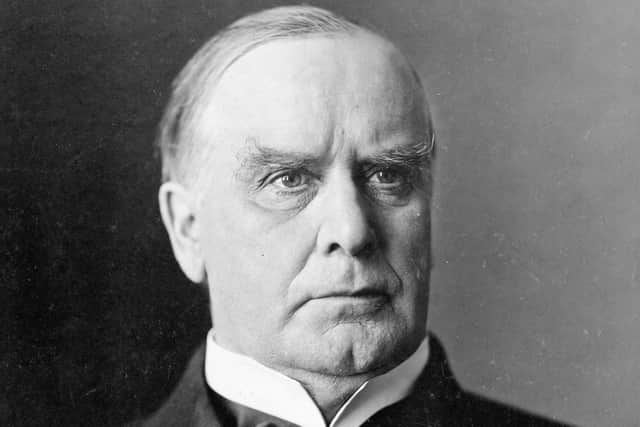

This event provoked a serious divergence of opinion between President McKinley and Theodore Roosevelt, his assistant secretary of the Navy. Both men were Ulster-Scots.
William McKinley was the great-great-grandson of James McKinley who had emigrated from Conagher, Co Antrim, in the mid-1740s. Between 1892 and 1896 William McKinley was governor of Ohio, a prelude to becoming the 25th president of the United States in 1897.
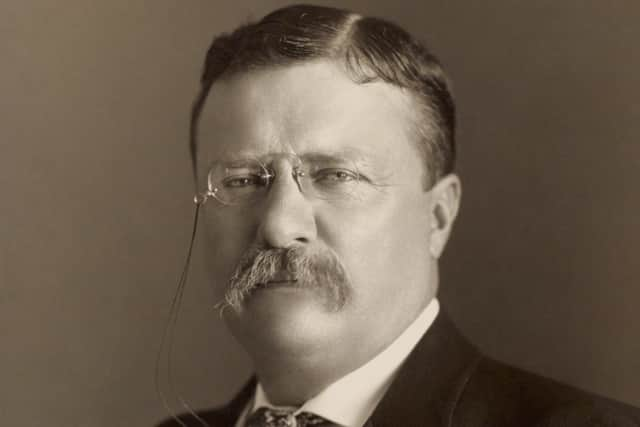
Ancestors of Martha Bulloch, Roosevelt’s mother, had emigrated from Larne in 1729. He referred to his Ulster-Scots ancestors as ‘a stern, virile, bold and hardy people who formed the kernel of that American stock who were the pioneers of our people in the march westwards’.
The explosion was probably the result of an accident. Waking up President McKinley to break the news, Commander Francis Dickins described it as such. Captain Philip Alger, an expert on ordnance and explosives, posted a bulletin at the Navy Department the next day stating that the explosion had been caused by a spontaneous fire in the coal bunkers.
This infuriated Roosevelt who protested that such a conclusion was premature. He contended: ‘Mr Alger cannot possibly know anything about the accident. All the best men in the Department agree that, whether probable or not, it certainly is possible that the ship was blown up by a mine.’
Americans were broadly sympathetic to Cuban independence and many Americans, without waiting for any evidence, were quick to blame the Spanish for the outrage.
Such sentiment was assiduously fostered by the ‘yellow press,’ spearheaded by William Randolph Hearst and Joseph Pulitzer, proprietors of the New York Journal and the New York World respectively.
The ‘yellow press’ had absolutely no interest in legitimate and properly researched journalism. Its sole concern was in sensationalism and lurid headlines to maximise sales.
Hearst and Pulitzer inflamed public opinion with the exhortation to ‘Remember the Maine’, and publicised alleged Spanish repression to encourage a demand for war. The hue and cry for war in a year of mid-term elections ultimately proved irresistible, evidencing the ever-growing influence of the press.
As a Methodist and a civil war veteran, McKinley was no warmonger: ‘I shall not get into a war until I am sure that God and man approve. I have been through one war; I have seen the dead pile up; and I do not want to see another.’
Theodore Roosevelt, who enjoyed the support of hawkish senators, attacked McKinley for trying to cool the situation and accused him of having ‘no more backbone than a chocolate éclair’.
Eventually, on April 11 McKinley asked Congress ‘to authorise and empower the President to take measures to secure a full and final termination of hostilities between the government of Spain and the people of Cuba … to secure in the island the establishment of a stable government … and to use the military and naval forces of the United States as may be necessary for these purposes’.
This prompted Spain to declare war on the United States on April 24. As Congress had already authorised the use of armed force, the United States formally declared war on April 25.
Roosevelt resigned as assistant secretary to the Navy to lead a volunteer cavalry unit known as ‘the Rough Riders’ in Cuba.
On July 1 1898 he famously led a cavalry charge up San Juan Heights, mounted on his horse Little Texas and waving his hat. He relished war as a sport, regarded July 1 1898 as ‘the greatest day of his life’ and achieved celebrity.
In the 100-day war, a very one-sided conflict, the United States destroyed the Spanish fleet outside Santiago harbour in Cuba, seized Manila in the Philippines, and occupied Puerto Rico.
McKinley had originally declared that the annexation of the Philippines would be ‘an act of criminal aggression’. Clearly, he had changed his mind. In doing so he was simply bowing to public opinion. Joseph Cannon, a future Speaker of the House of Representatives, claimed McKinley ‘kept his ear so close to the ground that it was full of grasshoppers’.
According to an elderly supporter named James F Rusling, McKinley offered fellow Methodists the following justification for taking over the Philippines in 1899:
‘(1) That we could not give them back to Spain – that would be cowardly and dishonourable; (2) that we could not turn them over to France and Germany – our commercial rivals in the Orient – that would be bad business and discreditable; (3) that we could not leave them to themselves – were unfit for self-government and they would soon have anarchy and misrule there worse than Spain’s was; and (4) that there was nothing left for us to do but to take them all, and educate the Filipinos, and uplift and civilize and Christianize them.’
Historians generally accept this as an accurate reflection of McKinley’s views but think it improbable that he employed those specific words.
Although a very reluctant belligerent, the war enhanced McKinley’s reputation because he proved to be an extremely effective war president.
The war proved beneficial to Roosevelt’s career too, enabling him to be elected governor of New York in the autumn of 1898. An activist governor, he was an advocate for workers’ rights and antagonised some Republican bosses by his vigorous opposition to corruption.
They concluded that Roosevelt would cause less bother as vice-president and so he became President McKinley’s running mate in June 1900.
When an anarchist shot McKinley early in his second term in September 1901, Roosevelt became the youngest-ever president at the age of 42.