
Magherafelt-born actor and writer, Ruairi Conaghan, talks about his play based on his uncle, Judge Rory Conaghan's murder by the IRA; portraying David Trimble; appearing in Downton Abbey; and taking on the role of Brighton bomber Patrick Magee
When Magherafelt-born actor and writer Ruairí Conaghan tours his play, Lies Where it Falls, at venues across Northern Ireland this month, he brings with him a story that is as personal as it is political.
The acclaimed one-man play centres on the murder of his uncle, Judge Rory Conaghan, who was killed by the IRA during the Troubles. While the subject matter is harrowing, audiences have been moved by the play’s humanity, humour, and emotional depth.
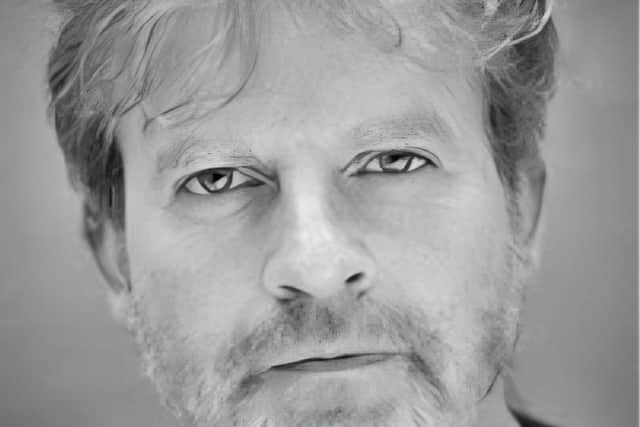

“I’ve not written a miserable dirge about the murder of my uncle,” says Ruairi. “It deals with political issues, it deals with a weighty subject, but it entertains with song, comedy, Shakespeare, storytelling and various characters. It really offers hope at the end. It's a story of recovery."
Judge Rory Conaghan - after whom Ruairi is named – was one of Northern Ireland’s first Catholic judges. A liberal, constitutional nationalist, he was widely respected across community lines.

On the morning of September 16, 1974, Judge Conaghan, 54, was having breakfast with his family in Belfast when the doorbell rang.
“He went to answer the door to the postman, holding his nine-year-old daughter Deirdre’s hand, and he was shot,” says Ruairi. “The postman was actually an IRA assassin. He died in my cousin's arms.”
The Provisional IRA claimed responsibility for both his murder and that of magistrate Martin McBurney who was also shot that morning in a separate incident.
“The murder of my uncle was never explained or justified by the IRA and no on was ever convicted,” says Ruairi. “However, we do know certain things – that it involved two men and a woman, and it was the Belfast brigade. The only contact I ever had with anyone, within or part of republicanism, was when someone approached me in London and said that my uncle's murder was a mistake. I challenged that by saying, ‘how could it be a mistake when it was so clinical, and so many Catholic judges were murdered at that time?’. It was given to me that it was a war and in wars, mistakes happen.”

At the time of the murder, Ruairi was just eight years old – just days earlier, his uncle Rory had attended his birthday party.
“I had a beautiful safe childhood up until that moment. Then suddenly that was shattered.”
The now 58-year-old, former Rainey Endowed pupil, left Northern Ireland when he was 19 to study drama at John Moore’s University in Liverpool.
“Sharing Judge Conaghan’s name meant I was constantly asked if I was related, and the murder was still so raw and well-known. It was painful to carry that with me. Moving to England was a way to escape the shadow of the conflict, to reinvent myself, and focus on becoming an actor."
Ruairi found catharsis in writing Lies Where it Falls, which he first performed two years ago at Belfast’s Accidental Theatre, followed by a short run at the Lyric Theatre. From there, it gained momentum—picked up by a producer, was taken to Edinburgh, and later London, where it received critical acclaim and award nominations.
“It's a play about recovery. Other people also find the catharsis with it. They recall their own stories and their own experience – not just about the conflict (in Northern Ireland).”
Audiences from other divided societies also felt that resonance when he portrayed David Trimble in Owen McCafferty’s Agreement.
“Agreement is a play that is truly international and people have responded to it because it's a story of a peace process that worked.”
In portraying David Trimble, Ruairí says he gained a deeper understanding of the man behind the politics.
“My family were very involved in the SDLP, my father was in the executive for a while. I was brought up in the environment of constitutional nationalism, democracy and liberalism. And when the Nobel Prize was announced, I felt John Hume should have got it alone, I didn't feel that Trimble should have been a part of that. But since having played the man, and researched the man, I absolutely have done a complete 360 on that, he absolutely deserved that Nobel Prize.
"He was a difficult man, he was a curt man, he was hard to like a lot of the time, but that leap that he made, and that journey that he put himself through, with risk to himself, his wife Daphne, and his family, was a true act of courage. And he maybe has saved, hundreds, thousands, of lives by the decision that he made.”
Lady Trimble attended a performance of Agreement, and although Ruairi didn’t meet her, he received what he calls the “unofficial seal of approval.”
Even more emotionally fraught was playing Patrick Magee, the Brighton bomber who killed MP Sir Anthony Berry, in the controversial play, The Bombing of the Grand Hotel.
The role, part of a piece exploring reconciliation between McGee and Berry’s daughter Jo, demanded that Ruairi confront his family’s trauma directly. As part of preparing for the role he met Magee in person.
“It was the first time I’d engaged with a republican. I needed to understand the man. But beneath the surface of that meeting was a simple, brutal truth—these were the people who murdered my uncle, and who had threatened my father.”
He describes the meeting as “civil”, but internally, his mind was in turmoil.
“I was sitting across from him, my head going crazy. So when I performed the play, I didn’t just play Pat—I played the subtext. I played what was going on inside me.”
While the performance seemed successful on the surface, the emotional price came shortly after. Ruairi moved almost immediately into performing the role of the Player King in Hamlet, played by Benedict Cumberbatch, at the Barbican. In the famous speech describing the murder of King Priam by the young assassin Pyrrhus, something visceral was triggered.
“For some reason, during that speech, I saw my uncle’s murder. It wasn’t every night. Just certain moments. But I started to get very physically sick. My body collapsed. I would go 54 hours without sleep. Then my mental health collapsed. And my own mortality felt threatened.”
What saved him, he says, was the love and support of his family. His recovery also involved medication, therapy, CBT, and time spent in Donegal.
“There’s something Victorian about it. Like going to sea for healing. I love bad weather. And Donegal in winter, you don't get wilder than that."
After he got better, Ruairi, who is married to fellow actor Catrionia Hinds (sister of actor Ciaran Hinds) and has a teenage son, Sé, moved back to Belfast in 2020 from London, where they had lived for 25 years.
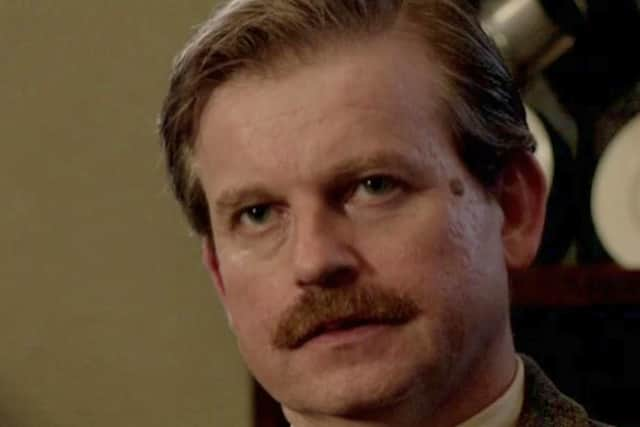
Ruairi, who credits his mother, Marie Conaghan—a key figure in amateur theatre and former chair of the Arts Council in Magherafelt—for nurturing his love of performance, has built a career spanning theatre, film, and television, including a role as Kieran Branson in Downton Abbey. Latterly, he’s been narrating audiobooks —including Portrait of the Artist by James Joyce and those written by Lisburn-born, former Newcastle United footballer, Paul Ferris.
So what’s next for Ruairí Conaghan? “I always thought there was just one play in me—and I’d written it,” he says, referring to Lies Where It Falls.
However, the play’s success has sparked new creative energy and ideas are “brewing in his head”.
“This time, I want to write a full play—not just a one-man show. I want to give other actors work.”
As for Lies Where It Falls, he hopes to tour it further—bringing the story to audiences across the Republic of Ireland next.
“That’s the next project,” he says. “But right now, it’s brilliant bringing it around the North. The conversations it’s sparked have been incredibly rewarding.”
*Lies Where it Falls is at the Market Place Theatre in Armagh on June 18, Seamus Heaney Homeplace in Bellaghy on June 19, the Playhouse in Londonderry on June 20, Belfast’s Lyric theatre from June 24- 29, and the An Grianan Theatre in Letterkenny on July 12.