
Oswald Swanzy, RIC officer tracked down to Lisburn and murdered by IRA in 1920
Oswald Ross Swanzy was born in Castleblayney, Co Monaghan on July 15 1881. He was the son of James Swanzy, a Monaghan solicitor, and his wife, Elizabeth Coudy Ross. James Swanzy died in February 1907.
Their elder son, Henry Hubert Swanzy, a captain in the Royal Army Medical Corps, died of plague contracted in the discharge of his duty in India later the same year on April 10. He was 28 at the time of his death.
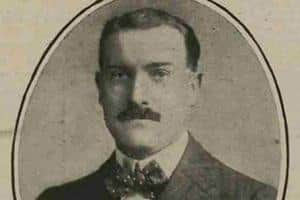

According to the 1911 census Oswald was living in Athy Street in Carlow with his 51-year-old widowed mother and Irene, his 24-year-old sister, and two servants.
Oswald had joined the RIC on the February 28 1905 (with register number 61367), and was appointed a 3rd Class District Inspector on May 6 1905 and allocated to Swanlinbar on September 15 1905.
On June 1 1907 he was promoted to a 2nd Class District Inspector and a decade later he was promoted to a 1st Class District Inspector. After Swanlinbar he served in Rathkeale, Carlow and Cork City.
On March 20 1920 Tomás Mac Curtain, the Sinn Fein lord mayor of Cork and brigadier of the No1 Cork brigade of the IRA, was killed in front of his wife and son by a group of men with blackened faces.
The killing was held locally to have been in retaliation for the murder of Constable Murtagh, who had been killed as he walked along Pope’s Quay, returning from the funeral of a RIC colleague, Constable Healy, who had been murdered leaving church in Co Tipperary on St Patrick’s Day.
At the inquest into the death of Mac Curtain, an outlandish verdict of wilful murder was returned against Lloyd George, the prime minister; Lord French, the Lord Lieutenant of Ireland; Ian McPherson, late Chief Secretary of Ireland; Acting Inspector General Smith, of the Royal Irish Constabulary; Divisional Inspector Clayton of the Royal Irish Constabulary; District Inspector Swanzy and some unknown members of the Royal Irish Constabulary.
During cross-examination at the inquest, Swanzy claimed he knew nothing about the shooting until 9.00 the following morning and insisted all ammunition at his barracks was fully accounted for. However, the jury did not find his testimony credible. (The jury was never disposed to finding Swanzy’s testimony credible.)
Of those named in the jury’s verdict, District Inspector Swanzy was the easiest (and therefore the most obvious) target for any IRA reprisal and was accordingly sent by his superiors to Lisburn.
Although Florrie O’Donoghue, an IRA intelligence officer and future historian, afterwards expressed doubts on Swanzy’s guilt, Michael Collins was convinced that Swanzy had been the leader of the party of unidentified men who had killed Mac Curtain.
Collins and Mac Curtain were friends and just before Christmas 1919 they had been party to an unsuccessful bid to murder Lord French at the entrance to Phoenix Park. Collins was determined to avenge Mac Curtain’s death.
With the help of Sergeant Matt McCarthy, an IRA mole in the RIC, Collins was able to establish that Swanzy was in Lisburn, living at 31 Railway Street. The IRA mounted two amateurish operations to kill Swanzy before they succeeded: one in Downpatrick and in Lisburn on August 15.
Sean Culhane, the intelligence officer of B Company of the IRA's First Cork Battalion, was sent to Belfast to rendezvous with local IRA men. On Sunday August 22 Culhane and a number of IRA gunmen travelled by taxi to Lisburn.
Using Mac Curtain’s own revolver, Culhane shot Swanzy at point blank range behind the right ear just after one o’clock as he left Christ Church Cathedral after morning prayer. Swanzy, who died at the scene, was also shot by Dick Murphy, another Cork IRA man and Roger McCorley, a Belfast IRA man.
The murderers escaped in the taxi which had been waiting for them in front of the Technical College in Castle Street. The vehicle had already started to move off before McCorley reached it and he was obliged to hurl himself into the car.
McCorley landed in a heap on the floor, accidentally discharging a round from his revolver inside the cab. A member of the public noted the taxi's number as it left Lisburn and Sean Leonard, the driver, was arrested later that afternoon.
Leonard, who was an IRA member, told police he worked for the Belfast Motor Cab and Engineering Co at Upper Library Street. At 11.45am, he said, he had been sent to the Great Northern Railway Station in Great Victoria Street to collect a fare who wanted to 'take a run along the Co Down coast'. Leonard was later tried for the killing of DI Swanzy.
Travelling back to Dublin after the murder, Culhane recalled that ‘on the train passing through Lisburn we noticed a number of houses on fire’. The murder had provoked arson attacks directed at Lisburn’s small Roman Catholic community, especially those perceived as having Sinn Fein sympathies. Protestant clergy, including the Rev H B Swanzy, Oswald’s cousin, unsuccessfully remonstrated with the rioters on behalf of DI Swanzy’s mother and sister.
In February 1921 a memorial in the form of a brass tablet mounted on Irish oak was erected by Swanzy’s mother and sister on the north nave of the cathedral.
The inscription reads: 'In proud and loving memory of Oswald Ross Swanzy, DI, Royal Irish Constabulary, who gave his life in Lisburn on Sunday August 22, 1920 and his gallant comrades who, like him, have been killed in the unfaltering discharge of their duty and in the service of their country. Be thou faithful unto death and I will give you a crown.’
Irene, who had idolised her brother, placed an ‘In Memoriam’ notice in the News Letter every year over six decades until her own death.
The Swanzys were an interesting family. One relation had been the wife of Isaac Butt. H B Swanzy was a prominent figure in the Church of Ireland and an historian and genealogist of distinction. The artist Mary Swanzy was Oswald’s second cousin. She has been variously described as ‘Ireland’s first cubist’ and ‘the unsung heroine of Irish modernism’.
Sir Henry Rosborough Swanzy, her father, was knighted in 1907 for his work in ophthalmology in various Dublin hospitals and Mary Swanzy (née Denham), her mother, was a direct descendant of John Knox.