
Reluctant vice president Harry S Truman became of the USA's best presidents
Having been vice president for only 82 days, Harry S Truman became the 33rd US president on Franklin Delano Roosevelt’s death on April 12 1945.
He had been presiding over the Senate and had just adjourned the session for the day when he received an urgent message to go immediately to the White House, where Eleanor Roosevelt told him that her husband had died after a massive cerebral haemorrhage. (Although many leading Democrats thought that Roosevelt would not live along enough to serve a full fourth time, allegedly this never seems to have occurred to Truman.)

A stunned Truman asked Mrs Roosevelt if there was anything he could do for her; she replied, ‘Is there anything we can do for you? For you are the one in trouble now!’
The day after he took the oath of office, he told reporters: ‘Boys, if you ever pray, pray for me now. I don’t know whether you fellows ever had a load of hay fall on you, but when they told me yesterday what had happened, I felt like the moon, the stars and all the planets had fallen on me’.
During his brief tenure as VP, he had met with the president only twice. Roosevelt, who perhaps failed to appreciate how ill he was, made no effort to keep Truman in the loop about the administration’s plans. For example, he was kept in the dark about the Manhattan Project and the development of the atomic bomb. (Through Soviet espionage Stalin knew about the atomic bomb before Truman.)
Fortunately, although he lacked foreign policy experience, Truman proved to be an astute politician and capable administrator.
Truman’s four grandparents were all Americans of several generations’ standing who had settled in Missouri in the 1840s. His father’s side of the family was English. Although often overlooked as an Ulster-Scots president, the Youngs, his mother’s family, had their origins in Ulster. The ‘S’ in Harry S Truman stood for absolutely nothing, often a marker of Scotch-Irish heritage.
In 1934 he was elected to represent Missouri, his home state, in the US Senate. Greatly admired by his fellow Senators, he acquired a reputation as a man with an insatiable appetite for work.
During the Second World War, Truman achieved national prominence through chairing a Senate committee investigating war contracts that saved US taxpayers billions. In the spring of 1944 political journalists in Washington DC rated his contribution to the war effort second only to Roosevelt’s.
Truman became Roosevelt’s reluctant running mate in the presidential election of 1944. He was not FDR’s first choice because he would have preferred to stick with Henry Wallace, his vice-president but conservative Democrats were vehemently opposed to him because they did not relish the prospect of a Wallace presidency.
James F Byrnes of South Carolina was FDR’s second choice but he was too conservative to be acceptable to labour leaders.
Then FDR identified Truman as a compromise candidate who would be acceptable to both wings of the party. However, Truman loved the Senate too much and was extremely reluctant to leave it to run as VP. With some justification, he regarded the office as a demotion.
He told the chairman of the Democratic National Committee, ‘I don’t want to be vice president.’ And he made the very fair point, ‘I bet I can go down the street and stop the first 10 men I see and that they can’t tell me the names of two of the last 10 vice presidents of the United States.’
FDR piled on the pressure by suggesting that if Truman wanted to break up the Democratic Party in the middle of the war that would be his responsibility. Truman succumbed out of loyalty to the party.
During his presidency Truman took many historically important decisions which went far to shape the second half of the 20th century. He decided to drop the first atomic bombs on Hiroshima and Nagasaki to bring the Second World War to an end.
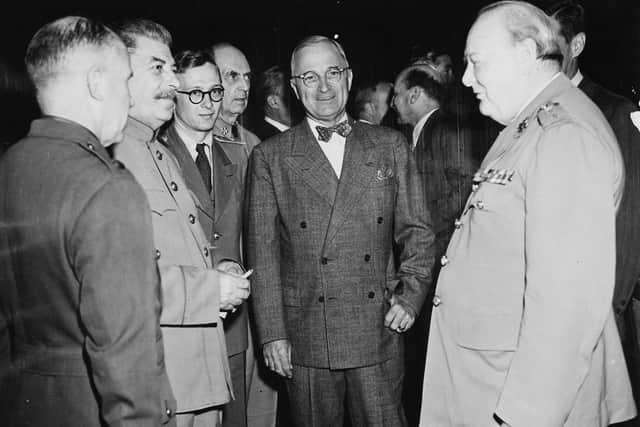
Truman had a more realistic appraisal of Stalin and Soviet Communism than FDR ever had. FDR viewed the British with greater suspicion than the Russians. In a speech to Congress in March 1947 Truman identified the Soviet Union as America’s greatest foe, declaring that the world had to decide between two ways of life – freedom or totalitarianism.
Thus, Truman was responsible for the Truman Doctrine, the Marshall Plan, the Berlin Airlift, the formation of Nato and intervention in Korea to prevent North Korea’s bid to take over South Korea.
Although a Democrat, Truman’s presidency is highly rated by Democrats and Republicans alike. Roy Jenkins in his brief but perceptive study of Truman offers a fascinating comparison between the 32nd and 33rd presidents: ‘Truman was in some ways the superior of Roosevelt. He did not have his style, his resonance, his confidence, his occasional sweep of innovative imagination, or his tolerance and understanding of diverse human nature. But he was less vain, less devious and better to work for. He was more decisive, and quite apart from Roosevelt’s physical disability, he had more sustained energy than the wartime Roosevelt … He was mostly better briefed, and not only in an immediate and superficial sense. He was at least as well read in history and biography as Roosevelt.’
In an interview in 1959 Truman said: ‘Some presidents were great and some of them weren’t. I can say that because I wasn’t one of the great presidents.’ He comforted himself with the observation: ‘Do your best, history will do the rest.’
History has been kind to Truman and deservedly so. Even so, he would be astonished by the praise historians have lavished upon him, especially for his foreign policy leadership.
Though unpopular when the 33rd president left office in 1953, with lengthening perspective his reputation has grown enormously over the years, and he now consistently ranks among the top US presidents.
Andrew Jackson was the first of a long line of Ulster-Scots presidents and is often regarded as the greatest. Jackson will always remain the first but arguably he is now surpassed by Truman as the greatest.