
Theodore Roosevelt hid serious health problem to lead his troops onto the beach at D-Day
Few US presidents have been prouder of their Ulster-Scots ancestry than Theodore Roosevelt, referring to his Ulster-Scots ancestors as ‘a stern, virile, bold and hardy people who formed the kernel of that American stock who were the pioneers of our people in the march westwards’.
In the US-Spanish War, on July 1 1898 the future president famously led the charge up San Juan Heights in Cuba, mounted on his horse Little Texas and waving his hat.
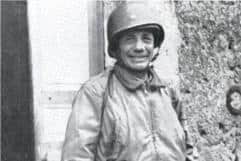

Brigadier General Theodore Roosevelt, the eldest son of the 26th president, was a chip off the old block. Edmund Burke’s observation about Pitt the Younger in 1781 springs to mind: ‘Not merely a chip of the old “block”, but the block itself.’
Brigadier General Theodore Roosevelt (known as either Theodore Roosevelt III or, more usually, Theodore Roosevelt Jnr) emulated his father’s Cuban heroics in Normandy on June 6 1944.
As the assistant divisional commander of the 4th Infantry Division, he was the only general on D-Day to land by sea with the first wave of troops.
At 56, he was the oldest man in the invasion, and the only one whose son also landed that day. Captain Quentin Roosevelt II (named after Theodore Roosevelt Jnr’s brother who was killed in the Great War serving as a pilot with the Army Air Service) was among the first wave of soldiers at Omaha beach.
As a young man, Theodore Roosevelt Jnr had pursued careers in banking and publishing but his ambition was to be a soldier.
He was one of the first to volunteer when the United States entered the Great War. By the conclusion of the war he was a lieutenant colonel and commander of the 26th Infantry Regiment and widely acknowledged to be the best battalion commander in his division.
Always solicitous of his men’s welfare, he bought combat boots for his entire battalion at his own expense. He carried a copy of ‘Pilgrim’s Progress’ into combat to read during the lulls in the fighting.
After the war, Roosevelt was instrumental in forming the American Legion, the US equivalent of the Royal British Legion.
Between the two world wars he had a political career and served as governor of Puerto Rico and governor-general of the Philippines.
In the Second World War, prior to D-Day, he served in the Operation Torch landings in North Africa and in the Tunisian campaign and the invasion of Sicily.
Before D-Day Roosevelt asked to accompany his troops ashore but the request was denied. He then submitted a written request, which was reluctantly approved. The division’s commanding general, Major General Raymond ‘Tubby’ Barton, did not expect Roosevelt to survive the attack.
If Barton had been aware of Roosevelt’s medical history, the original decision would surely not have been overturned. Roosevelt had a heart condition which he carefully concealed from Army doctors and his superiors.
As a result of various wounds sustained in the Great War, he suffered from arthritis and had to use a cane. He went ashore at Utah beach, relying on his cane and carrying a pistol.
Informed that the landing craft had drifted south of their objective and the first wave of men was a mile off course, he wasted no time in reconnoitring the area, thereby placing himself in great personal danger. Returning to the landing beach, he began coordinating the attack on the enemy’s positions. Opting to fight from where they had landed rather than trying to move to their assigned positions, Roosevelt famously announced, ‘We'll start the war from right here!’
Oblivious to enemy fire, even when clods of earth fell on top of him, he was ubiquitous in encouraging and rallying the men around him, directing them and personally leading them against the enemy.
When Major General Barton came ashore, he met Roosevelt not far from the beach. He later wrote: ‘While I was mentally framing [orders], Ted Roosevelt came up. He had landed with the first wave, had put my troops across the beach, and had a perfect picture (just as Roosevelt had earlier promised if allowed to go ashore with the first wave) of the entire situation.
‘I loved Ted. When I finally agreed to his landing with the first wave, I felt sure he would be killed. When I had bade him goodbye, I never expected to see him alive. You can imagine then the emotion with which I greeted him when he came out to meet me [near La Grande Dune]. He was bursting with information.’
By modifying his division's original plan on the beach, Roosevelt ensured the troops achieved their objectives – striking evidence of his exceptional military acumen.
Years later, Omar Bradley was asked to name the single most heroic action he had ever seen in combat. He replied: ‘Ted Roosevelt on Utah Beach.’
On July 12 1944, a little over one month after D-Day, Roosevelt died of a heart attack. On June 6 he had suffered chest pains but had kept quiet.
On the day of his death, he had been selected by Omar Bradley, now commanding the US First Army, for promotion to a two-star general (a major general) and command of the 90th Infantry Division.
These recommendations were forwarded to and approved by General Eisenhower, now the Supreme Allied Commander in Europe, but unfortunately Roosevelt died before the promotion could take effect.
Of his death, George Patton wrote: ‘Teddy R[oosevelt] died in his sleep last night ... He was one of the bravest men I ever knew.’
Although Roosevelt had strained relations with Patton and Bradley in the past, both men acted as pall bearers at his funeral.
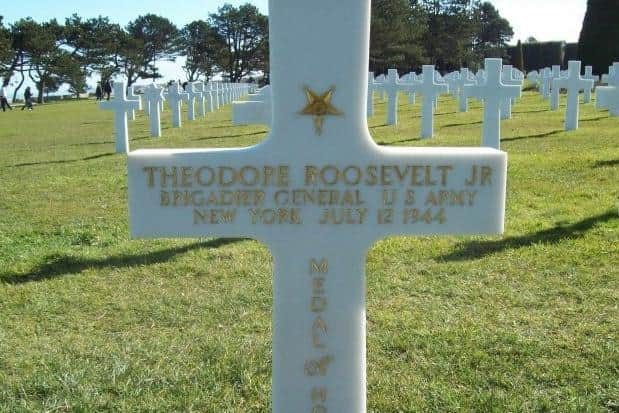
Originally buried at Sainte-Mère-Eglise, his body was then moved to the cemetery at Colleville-sur-Mer in Normandy. There it now rests alongside his younger brother Lieutenant Quentin Roosevelt who was shot down by two German fighters in July 1918.
At the time of his death, Roosevelt had been recommended for the Distinguished Service Cross in recognition of his heroism in Normandy. The recommendation was subsequently upgraded, and Roosevelt became a posthumous recipient of the Medal of Honor.