
Ulstermen rushed to sign up to serve in World War One, despite the threat of Home Rule
Sir Edward Carson and close political colleagues spent the bank holiday weekend before the United Kingdom’s declaration of war on Germany in 1914 at Wargrave, overlooking the Thames, as guests of Sir Edward Goulding, a leading southern Irish Unionist.
They met to consider the evolving political situation in Ireland but their deliberations were overtaken by events in Europe. Even before war was declared, Carson assured Captain Wilfrid Spender on August 3 1914 that ‘a large body of Ulster Volunteers will be willing to give their services for Home Defence and many will be willing and ready to serve anywhere they are required’.
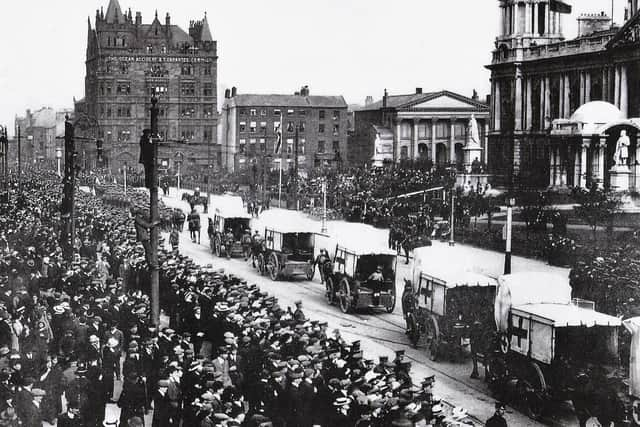

Spender had spoken to Carson on behalf of friends on the Committee of Imperial Defence and his response was promptly relayed to them. Two days later the secretary of the Ulster Unionist Council received the following telegram from Carson: ‘All officers, non-commissioned officers, and men who are enrolled in the Ulster Volunteer Force, and who are liable to be called out by His Majesty for service in the present crisis are requested to answer immediately His Majesty's call as our first duty, as loyal subjects to the King.’
Some 4,350 army reservists who were active in the UVF returned to their former regiments on the outbreak of war. Furthermore, several hundred men joined various Irish regiments and English and Scottish units before the creation of the Ulster division.
The war confronted Carson with a dilemma: as a patriot he knew where his duty lay but at same time he did not trust Asquith, the Liberal prime minister, whom he feared would press ahead and implement Home Rule. Carson privately expressed his mistrust of the government in a letter on August 5 to his fiancée, Miss Ruby Frewen: ‘I am very much depressed, as I fear the Government mean, if they can, to betray us, and pass the Home Rule Bill over our heads and whilst it is impossible to resist in Ulster owing to the difficulties caused by the present situation. They are such a lot of scoundrels I believe they are quite capable of anything.’
A telegram which Carson received from a UVF officer in Belfast underscored Carson’s dilemma: ‘Can we assure men before giving names for United Kingdom or foreign service no danger of Home Rule passing while they are away?’ Carson’s response was to park his doubts about the government and follow the path duty dictated.
Carson’s public stance (as revealed in a letter dated August 7 1914 to the lord mayor of Belfast and which was read at a public meeting held in the city hall) betrayed no hint of his dilemma: ‘Our loyalty is of no recent date but has been the foundation of all our political action and the motive power of our sacrifices to maintain our position in the United Kingdom. We will now be prepared to show once more without any bartering of conditions that the cause of Great Britain is our cause, and with our fellow citizens throughout the whole Empire, we will make common cause and suffer any sacrifice ...’
Privately, Carson hoped that it might be possible to extract a commitment from the government to put Home Rule in ‘cold storage’.
At the outset of war Asquith appointed Lord Kitchener as Secretary for War. Although the prevailing wisdom was that the war would be over by Christmas, Kitchener was convinced that the war would be protracted and would require the raising of a great New Army of the order of 70 infantry divisions (‘a million bayonets’) to bring it to a successful conclusion.
Recognising the military potential of the Ulster Volunteers, Kitchener wanted them for his New Army. He sent for Colonel T E Hickman, MP for Wolverhampton South, a leading figure in the British League for the Support of Ulster and the Union, and Inspector-General of the UVF, on August 7, and told him that he wanted the UVF. Hickman told Kitchener that he must see Carson and James Craig.
Carson’s first meeting with Kitchener got off to an unsatisfactory start because of Kitchener’s opening remarks: ‘Surely you’re not going to hold out for Tyrone and Fermanagh.’ Carson replied: ‘You’re a damned clever fellow, telling me what I ought to be doing.’
Kitchener initially refused to countenance Carson’s wish that the UVF should be kept together as a fighting unit and the suggestion that Ulster should feature in the name of the division they proposed to raise. Subsequently Carson and Craig unconditionally offered to put all the Ulster Volunteers at Kitchener’s disposal, assuring him that 35,000 of them were willing, if accepted, to enlist and go abroad. In return, Kitchener relented on both the name and the exclusively Ulster composition of the division.
James Craig, on leaving the War Office after securing agreement, took his famous taxi ride to the firm of Moss Brothers and ordered 10,000 complete uniforms.
On September 3 1914 Carson addressed the Ulster Unionist Council in the Ulster Hall and told delegates that England’s difficulties were not Ulster’s opportunity: ‘However we are treated, and however others act, let us act rightly. We do not seek to purchase terms by selling our patriotism’. Carson urged the men of the UVF to ‘go and help save their country and their Empire’. The UUC enthusiastically approved his arrangements with the War Office. Carson reassured the UUC delegates: ‘On the question of Home Rule we stand where we always have been. It will never be law in our country. We will postpone active measure in the interests of the country and the Empire, but when the country is more safe we will assert our powers as before ... I never had any doubt from the first moment that Ulster would most willingly come to the front in giving all the assistance that was possible to the United Kingdom in the waging of this war...’
The North Belfast Regiment of the UVF claimed the honour of providing the first detachment of recruits. The special service battalion of that regiment paraded at Dunmore early on September 4 and was addressed by Carson. They then marched with Carson and Craig at their head to the Old Town Hall that had become a recruiting depot.
The first man to pass the medical examination and become the first recruit was William Hanna of 43 Brussels Street, a 44-year-old veteran of the Boer War. On the opening day 600 men went before the doctors and only 40 were rejected. The following day men from the East, South and West Belfast battalions and the Young Citizens Volunteers began enlisting. Outside Belfast, anticipating the formation of the Ulster Division, Ambrose Ricardo had raised two companies from the Tyrone UVF that were to become the nucleus of the 9th Battalion of the Royal Inniskilling Fusiliers.
Carson insisted that winning the war was the only consideration, whatever the government might do in regard to the situation in Ireland, a reference to Asquith’s decision to allow the Home Rule Bill to become law on September 18 but accompanied by a bill to suspend its operation until the end of the war. Although Carson described this as ‘an act of unparalleled treachery and betrayal’, recruiting continued and Asquith in the House of Commons paid tribute to the patriotic spirit of the UVF that had made the coercion of Ulster ‘unthinkable’.