
Allister to test key pledge in Safeguarding the Union deal ahead of Stormont vote on Irish Sea border
The effectiveness of a key pledge in the Safeguarding the Union command paper is set to face its first real test – as the TUV write to both the UK and Northern Ireland attorney generals asking whether it would impede an upcoming Assembly vote on the Windsor Framework.
MLAs will vote in little over a week on whether to keep the Windsor Framework in place – but Jim Allister is challenging the government on legal changes to the EU Withdrawal Act, made as part of the DUP-Tory deal in January.
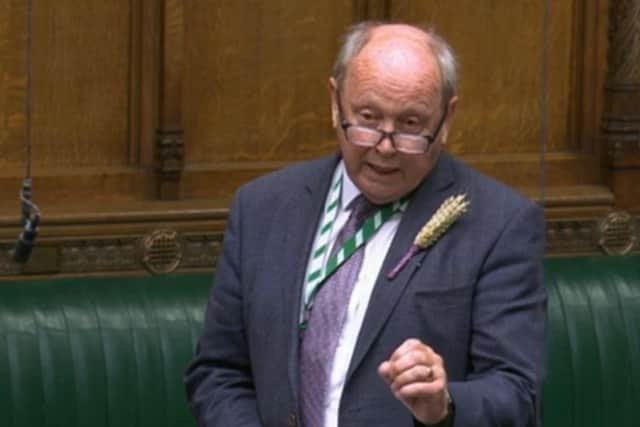

The TUV boss argues that a Stormont vote in favour of keeping the trade deal in place would undermine the Acts of Union – legislation which was supposed to be central to Northern Ireland’s constitutional position under the Safeguarding the Union (STU) deal.
The document pledged legislation to “copper-fasten Northern Ireland’s integral place in the United Kingdom, fulfilling the Acts of Union 1800; strengthen the UK’s internal market; and safeguard new protections into the future”. Amendments to the EU Withdrawal Act followed which cite the 1800 Acts of Union.
Mr Allister and MLA Timothy Gaston have written to the UK Attorney General and the NI Attorney General respectively to query the matter – seeking advice on “the legality and efficacy” of the upcoming consent vote.
Their letter says “The principle of legality would be offended if the Assembly is to be asked to vote to renew Articles 5-10 of the Windsor Framework, and the effect of an affirmative outcome would be to act contrary to the law in so far as the effect of those provisions create an inconsistency with Article 6 of the Acts of Union in breach of section 38 (4) and (5) of the 2020 Act”.
When selling the STU deal, former DUP leader Sir Jeffrey Donaldson heralded the amendments to the EU Withdrawal Act. He said the legislation would “provide new legal and practical protections for the Acts of Union”. However, party colleague Sammy Wilson said that the STU deal hadn’t removed EU control – and said “it is just not true” that the foundational importance of the Acts of Union is respected by the government.
Jim Allister MP told the News Letter: “On 10 December the NI Assembly is invited, on direction from the Secretary of State, to approve the application to Northern Ireland of Articles 5-10 of the Protocol (Windsor Framework) for another 4 or 8 years.
“The effect of an affirmative outcome is to keep Art 6 of the Acts of Union in suspension - the Supreme Court having held that these Protocol Articles, particularly Article 5, being incompatible with the free and unfettered inter-UK trade guaranteed by Art 6 of the Acts of Union, have the effect of putting the said Art 6 into suspension.
“Thus a vote by the Assembly to approve the motion is a vote to keep Article 6 in suspension and thereby continue to infringe the constitutional status of NI.
“When the Supreme Court awarded the Protocol over the Acts of Union we did not have Section 38(4)&(5) of the EU Withdrawal Act 2020".
“The purported effect of section 38(4)&(5) is to define the constitutional status’ of NI as inclusive of the Acts of Union. It follows, that if, as the Supreme Court has held the Protocol suspends a key provision of the Acts of Union, Article 6, then, it cannot in law be ‘without prejudice’ to the constitutional status of NI, as now required by law!
“Hence, the efficacy of the ‘democratic consent’ motion is thrown into doubt. How can the Assembly be invited to approve infringement of that now set forth in legislation, namely, Section 38 of the EUWA 2020?
“In our determination to have this key issue addressed Timothy Gaston has written to the NI Attorney General... as I have to the UK Attorney General”.
The letters ask the top government lawyers “how can that which is to be applied ‘without prejudice’ to the Acts of Union, simultaneously bring about the prejudice of subjugation and suspension of a key provision of the same Acts of Union?”