
Belfast Trust accused of ‘eating up’ funds amid hospital overruns
Belfast Trust has been accused of “eating up” money from Northern Ireland’s health budget as leaders faced questions on projected overspends of large-scale projects
DUP MLA Diane Dodds said major capital projects being run by the trust had become a “shambles” as officials gave an update on their financial situation in the continued absence of an agreed 2026/27 budget at Stormont.
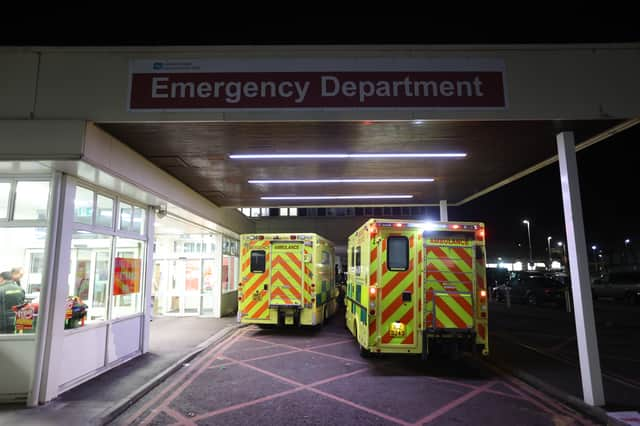

The new Children’s Hospital in Belfast has faced years of delays, escalating costs and concerns over work to its water infrastructure, with its projected price rising and completion pushed back from 2020 to the early 2030s.
A new Belfast maternity hospital has also become a controversy, running years behind schedule and significantly over budget, with additional delays caused by contamination in its water system.
Referring to a briefing pack that had been sent by the trust to the committee Ms Dodds said: “It’s very strange to get a paper on four different schemes, which involve different overruns of money, overruns in terms of completion time, and significant technical details, but very little in terms of cost to the taxpayer in Northern Ireland, and that I think is very, very concerning.
“I’m not going to rehearse it all, I’ve always said before, but this is a situation that simply cannot continue.
“We cannot continue with the Belfast Trust eating up the significant budget that it does in terms of capital schemes, the significant amounts of money that will be required to put these schemes right and meantime, in Antrim, we cannot replace Holywell, we cannot do anything about Craigavon area hospital, we cannot get to a stage where we’re building a mother and baby unit.
“It’s just not right, and it needs to be sorted out.”
She added: “It’s also not just about the Belfast Trust, it’s about all of the money for all of the capital projects across Northern Ireland that no longer can take place because the trust is eating up this money.”
Turning to the children’s hospital, she asked if it was going to cost the trust £54 million to correct the water issues, resulting in a total overrun of £126 million; and if the estimated completion date is now 2031.
David Porter, director of strategic development at the trust, said he could not provide “firm costs at this point” as they only currently have estimates from a contractor that are being challenged.
“I cannot report to the committee until I have certainty of accuracy of all of these, and this is an ongoing process,” he said.
Ms Dodds said: “You’re not prepared to give any advice in terms of overruns in budgets, or estimates to changes to the water system to this committee, or to the wider public in Northern Ireland, who are watching with interest the shambles that this has become?”
Mr Porter replied: “There’s a degree of commercial sensitivity to this as well you’ll appreciate, and that those are ongoing discussions and so on with the contractor at present, those are love and there are commercial implications to all of that, so I’d be hesitant to make anything public at the minute.”
Opening the session, Jennifer Welsh, chief executive of the trust outlined their saving plans against a projected health and social care funding shortfall of £800 million, which she described as “hugely challenging”.
She outlined that health trusts in Northern Ireland had been “directed to progress all savings measures that could be delivered without causing harm to service users” to save 4% of their budget, as well as addressing underlying deficit.
“For Belfast Trust, the requirement to address its underlying deficit represents a further £29 million, or 1.4% of the revenue resource level, resulting in the total in-year savings requirement of 5.4%,” she told the committee.
She said the savings plan is divided into two phases, with phase one comprising “minimal impact efficiency measures”.
“That’s not to say that they’re straightforward or easy, they’re hugely challenging,” she said.
“But with minimal impact to patients and a total value of £67.9 million.
“£29 million of these is required to offset the trust’s underlying deficit, as I mentioned, and therefore 1.9% actually contributes towards the peak target of 4% savings.
“In August 2026, the trust board approved tranche one of phase two savings proposals.
“These schemes were assessed by SPPG (strategic planning and performance group) as low risk, and they were subsequently approved by the minister.
“In addition, a further tranche of savings, which have been subject to ongoing discussion, has now also received ministerial approval.
“These were discussed at our trust board this morning, and we are projecting to deliver £15.6 million of these top savings.
“So these savings are primarily made up of longer-term actions with a view to bringing us into financial sustainability.”