
'Day of humiliation' for UK as Irish Sea Border Control Post opened in Larne - Allister
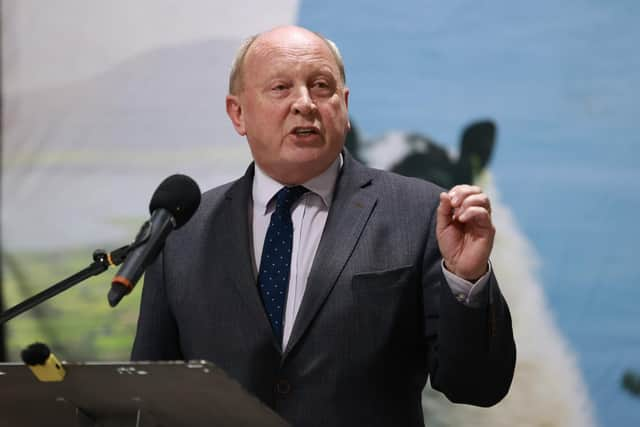
The division of the United Kingdom under the Windsor Framework has been ‘cemented in’ by the opening of a new border control post at Larne, Jim Allister has said.
On Monday, a new piece of Irish Sea Border infrastructure became operational at the County Antrim port – with Belfast due to have its facility put in place early next month.

The Border Control Posts (BCPs) are a requirement of the post-Brexit trade deal between the UK and EU – and are designed to allow the EU to monitor what products are entering Northern Ireland, which is treated as a part of the European single market.
Despite talk of an SPS deal between London and Brussels making such checks on animal and plant products redundant, the government has pressed ahead with honouring its commitments under the Windsor Framework “in good faith”.
In a statement released on Monday, the TUV leader said the Larne facility was the first major, permanent Border Control Post constructed to cement in a ‘hard’ Irish Sea Border, dividing the United Kingdom.
“The Port of Larne will witness an event of far-reaching constitutional importance for the people of Northern Ireland. The Port of Belfast will follow on 11 August.
“Today [Monday] we have imposed on us the experience of being cut off from what has been our Internal Market for Goods, the UK Internal Market for Goods, and of being forced, without consent, into an all-Ireland Internal Market for goods through the coming into service of the first major permanent Border Control Post.
“The Border Control Posts stand at the bar of the court of history as concrete evidence that far from our place in the UK Internal Market being protected, it has been replaced with a Great Britain Internal Market for Goods and an All-Ireland Internal Market for Goods.
“The UK Internal Market for Goods is now nothing more than a legal fiction to encourage people to live in denial, so the break-up of the UK can be secured with minimal opposition.
“Even under the green lane goods can only cross with an export number, international SPS and customs paperwork, subject to between 10 and 8% checks. Moreover, to the extent that some of the paperwork is simplified compared to the red lane, this is not a net benefit but in return for taking on the costs of alternative border frictions like having to successfully apply and maintain membership of a trusted trader scheme and carry Not for EU labels.
“The green lane effectively amounts to an alternative international border experience to the red lane. It certainly does not facilitate the unfettered movement of an internal market that we see in the flow of goods from England to Wales, or Scotland to England today, and which we saw when moving goods from GB to Northern Ireland before the advent of the Irish Sea Border.
“As the All-Ireland Internal Market for Goods is defined by laws made by Dublin, and the rest of the EU, which are then simply imposed upon us, these Border Control Posts serve a wholly ignoble purpose. They are there to protect the ‘integrity’ of the consequence of our disenfranchisement and secure the disruption of our best economic interests as we are forcibly alienated from the greater part of what has been our home economy for goods for more than two hundred years.
“Today is, as such, a day of humiliation both for the people of Northern Ireland and the United Kingdom as a whole, as we bow to the attempts of 27 European states to disrespect our territorial integrity and degrade our democracy both in direct violation of the Belfast Good Friday Agreement as international law”.
He said the current situation could be avoided by having a mutual enforcement system, backed by all unionist parties, but rejected by the UK and EU.
Mr Allister added: “If the UK is not prepared to stand up for itself and insist on a solution that respects its territorial integrity and does not result in the forced disenfranchisement of 1.9 million citizens, then it is doubtful – certainly under the current government – that it has a future.
“For the government of a country to succeed it needs to believe in itself and to defend the dignity of its people.”