
DUP councillors walk-out from Newry Mourne and Down District Council after Irish signs 'imposed' on unionist areas and 'block' on discussing Supreme Court transgender ruling


Unionists have walked out of Newry Mourne and Down District Council after it voted to impose new Irish language signs on unionist areas - and after being blocked from holding a discussion on biological men using women's toilets.
DUP councillors walked out of a full council meeting in Downpatrick on Monday night after what they said was six years of trying to reason with non-unionist parties at committee level about plans for new Irish-leading gateway signs for all towns and villages across the borough.
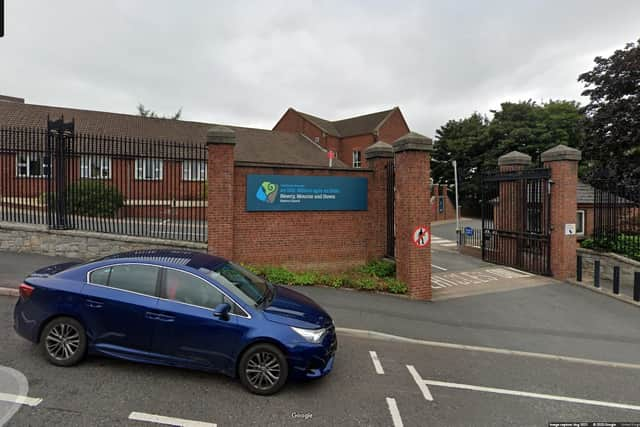
For around a decade the council has had some 18 boundary signs across the district - headed in Irish - which have been repeatedly replaced after suffering vandalism in areas such as Rathfriland, Killinchy, Saintfield, Ballynahinch and Killyleagh.
However, on Monday night the full council meeting voted to adopt a new policy to install similar signs at the entrances of all towns and villages – even those that voted against them in consultation.
In a statement, DUP councillors Callum Bowsie, Glyn Hanna, Jonathan Jackson, Alan Lewis and Henry Reilly said they walked out due to "the continued disrespect towards the DUP and those we represent".
Other parties were "forcing through Irish signage without the consent of unionists and refusing to allow the DUP to debate important issues in full council meetings" they added.
They had expressed concerns about imposing the policy in towns where "the vast majority of residents do not identify with or use the Irish language".
The council had ignored the views of District Electoral Area Forums which opposed the signs in a 2023 consultation, they said.
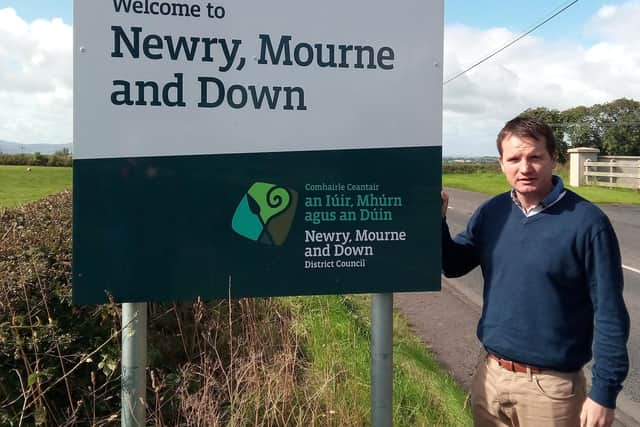
Unionists had discussed the issue at the council’s Equality and Good Relations Committee for six years but "majority rule" by Sinn Fein, SDLP and Alliance resulted in them "systematically" imposing the signs on every town and village.
This, they said, goes against the European Charter for Regional or Minority Languages.
Also on Monday night, the DUP attempted to table a motion about the Supreme Court ruling that biological sex defines gender – and how this applies to council toilets.
However they said they were refused, because it was deemed “controversial”, the matter being referred to the Equality and Good Relations Committee.
This contrasted with the full debate given to a "controversial" Sinn Fein motion about Irish presidential votes, they added.
UUP Councillor David Taylor said unionists approached the Irish sign issue “constructively” over 12 committee meetings, but republicans and nationalists "decided to ignore genuine unionist concerns".
There was "a clear mindset that only one viewpoint was going to be acceptable" which he said sends "a very negative message to the minority unionist community".
SDLP group leader Gareth Sharvin countered that his party "fully engaged" in the signage discussion with a view to creating a district that "brings all communities together rather than pushes them apart".
He added that it was "unfortunate” that after 13 meetings “agreement could not be achieved".
Taking issue with the DUP describing the trans matter as "controversial", he added that "we need to be aware of the words being used, as this is an extremely sensitive matter for people in our society".
In relation to the contrasting manner in which the DUP and Sinn Fein motions were handled, a council spokesman said, standing orders require any matter arising at full council which comes under the remit of a committee to be passed to it without discussion. However, the chairperson may allow it to be discussed if they consider it “urgent and necessary”.
Sinn Fein and Alliance were invited to comment.