
DUP top brass have 'constructive' meeting with Irish deputy about Troubles legacy - but voices 'disappointment' with state's record
Three senior DUP members have met Irish deputy leader Simon Harris to talk about the legacy of the Troubles, in an encounter described by the unionist party as “constructive”.
However, the DUP also voiced “disappointment” at the Republic’s longstanding record on legacy.
The UUP did not meet Mr Harris because of “scheduling conflicts”, but the party added that “their meeting will be happening at a later date”.
The Irish government is currently suing the UK government over the Legacy Act, which was designed to shut down police probes and inquests into Troubles killings.

The Irish government claims the act breaches the European Convention on Human Rights (ECHR), and today Mr Harris said the UK and Irish governments are working intensively on a revised framework for dealing with the Troubles in the coming weeks.
"I'm conscious this is an extraordinarily sensitive area,” he told the media at Stormont.
"But I have been working intensively with the Secretary of State for Northern Ireland in recent months really to see if it is possible to find a landing zone that can allow the two governments to agree a framework in terms of legacy issues in the coming weeks.”
He added that he wants to “move beyond the dark shadow and the huge pain caused by the Legacy Act as it currently is, to a much higher terrain where there's an infrastructure around legacy that's human rights compliant, that's victim-centred, and that can provide confidence across the communities in Northern Ireland and across the island of Ireland".
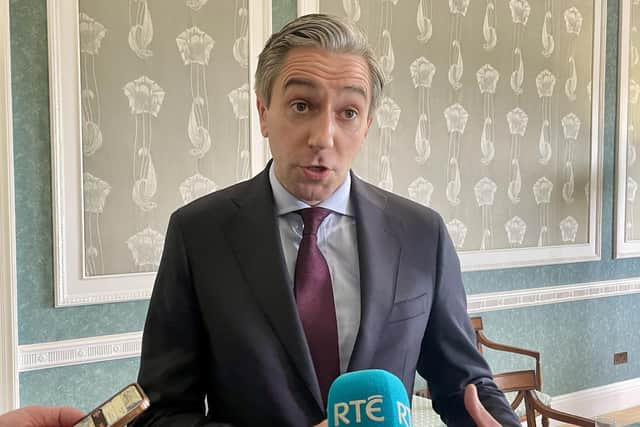
He also backed a public inquiry into the murder of Catholic civilian Sean Brown in 1997, saying “I want the family to have truth and justice that has been denied to them to date, and I want them to have it in a way that is Article Two compliant” (Article Two being the section of the ECHR which deals with the obligation to investigate killings).
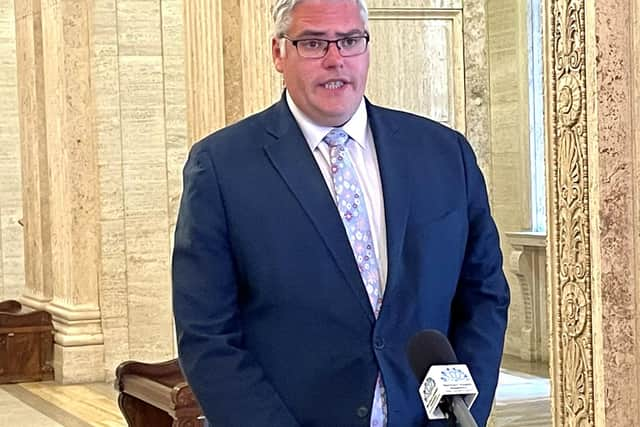
The DUP meeting with Mr Harris involved party leader Gavin Robinson, deputy leader Michelle McIlveen, and deputy first minister Emma Little-Pengelly.
Afterwards, Mr Robinson said in a statement: “We had a constructive exchange with Simon Harris this morning on the important issue of legacy.
"While we welcome ongoing engagement, we remain disappointed by the Irish Government’s longstanding approach.
"For decades, there has been a failure by the Irish Republic to step up to support the quest for truth and justice.
"No credible investigative mechanism, repeated obstruction of extraditions, and a reluctance to support victims’ pursuit of justice. That has left many families in Northern Ireland, and indeed in their own jurisdiction, feeling ignored.”
He also said that the Irish state’s co-operation on the Omagh bomb inquiry “falls well short of what is needed”, and that “more must be done”.
The was not part of the scheduled meetings with Mr Harris. When asked to comment on the Irish state’s position, it said: “For the entirety of the PIRA campaign the Republic acted as a safe haven for terrorists from which they could launch attacks and to which they could flee save in the knowledge that once over the border there was little prospect of them facing justice.
“Figures published by the House of Commons show that between 1973 and 1997 there were 110 requests for extradition from the Republic of Ireland by the UK. Of those, just eight were successful.
"Frequently, terrorists successfully cited the constitution of the Irish Republic when fighting attempts to bring them back to face justice in Northern Ireland.
"Even after the Anglo-Irish Agreement – in which Dublin promised increased cooperation on security – the situation failed to improve. Terrorists successfully cited the Irish constitution which laid claim to Northern Ireland when seeking to escape justice for crimes committed in Northern Ireland.
"Not only that but there are numerous examples of cases where outright collusion between the Garda and the IRA is suspected. The horrific murder of three members of the Hanna family as they returned from a holiday in Disneyland in 1988 is one particularly notable example.
"The family of Ian Sproule to this day have unanswered questions as to how an inaccurate Garda file ended up in the hands of the IRA, something which resulted in murder.
"In both the Hanna and Sprole cases Dublin has ignored repeated calls from the families for inquires.”