
Father of Willie Frazer: Police Ombudsman Marie Anderson finds RUC failed family on Bertie Frazer IRA murder


The Police Ombudsman has found the RUC investigation into the "sectarian" IRA murder of Bertie Frazer failed his family - calling the level of record keeping “a stark example of limited police record management".
Responding, PSNI Assistant Chief Constable Anthony McNally from Justice Branch, said Mr Frazer was an “innocent father of nine” who was murdered in “a sickening, sectarian attack”.
He said policing had “developed enormously” since the 1976 murder.
In her report to the family, the Police Ombudsman of Northern Ireland (PONI) Marie Anderson stressed concern about the junior rank of the officer leading the investigation, witness and suspect strategies, the disposal of the weapon and lack of engagement with the family.
Bertie’s son Joe Frazer said: "The Police Ombudsman report today has confirmed our worst fears, that the police investigation into our father's murder failed at every level. We have been vindicated in raising a complaint with the Ombudsman's Office."
The conclusions were made by Mrs Anderson before her retirement in December, in response to complaints made in 2013, 2014 and 2016.
Bertie Frazer, 47, a part-time UDR member, was shot dead as he left a farm he worked at near Whitecross. No-one has ever been convicted of his murder.
He was the father of victims’ campaigner Willie Frazer, who died in 2019.
PONI said the ‘South Armagh Republican Action Force’ – an IRA cover name – claimed Bertie's murder was in retaliation for the murders of Sean Farmer and Colm McCartney, who were shot dead at “an illegal vehicle checkpoint” near Newtownhamilton, a week earlier.
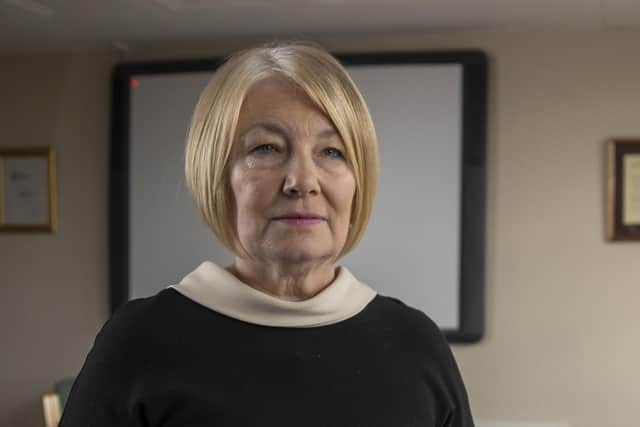
Mrs Anderson (pictured) concluded that Mr Frazer was “a victim of sectarian violence and PIRA alone was responsible for his murder, concluding that, from the failings identified, Mr Frazer’s family were failed by the RUC investigation into his murder”.
She said the initial police response to his murder was “prompt and reflected the standards of the day”.
Expert officers searched the scene, finding two 9mm bullet cases and the primary witness, in the nearby farmhouse, was interviewed.
Garda were informed and a military helicopter followed a car thought to be Mr Frazer’s before losing it.
There were no records of any house‑to‑house enquiries or searches, nor any record of enquiries along the gunmen's likely routes.
Eleven witness statements were found and Mrs Anderson was satisfied police spoke with three of them. A witness who passed Mr Frazer’s car being driven by someone else viewed three suspects, but did not recognise any as the driver.
The sub-machine gun used was recovered in 1976 but the next year a chief superintendent signed a disposal form for it. PONI could not trace it.
Mrs Anderson said an RUC patrol car had been stopped by an “illegal” vehicle check point (VCP) just before the Farmer-McCartney murders – and near the location they were found.
The Frazers believed that if the patrol had challenged the VCP and stopped the murders, the retaliatory murder of Mr Frazer would not have taken place.
The RUC officer in charge of the patrol told PONI he was “unaware of any planned military patrols taking place in the area, knew all the local UDR members and did not recognise the ‘soldiers’ at the checkpoint”.
He also stated that the apparent soldier who approached him had long hair, was wearing a blacked-out cap badge and did not have a south Armagh accent.
Suspicious, he alerted the RUC, Garda and Army, who did not deploy as they required permission.
The RUC officer told the Historical Enquiries Team in 2006 that he believed any challenge could have seen them shot.
The Frazer family also expressed concern about newspaper articles after the Farmer-McCartney murders in which SDLP councillor Seamus Mallon said he had “firm evidence” that a UDR patrol with blacked-out cap badges had performed a VCP in the area.
Mr Mallon told PONI his information came from a named senior police officer, who was deceased. PONI found no evidence that police spoke with Mr Mallon to establish the origins of his information.
PONI also found that a detective constable led the murder investigation but said a more senior and experienced officer “should have been appointed to lead”.
The Frazer family complained about the lack of engagement by police. PONI concluded that there was “clear value” to engaging with family as witnesses.
PONI was also unable to establish what happened to Mr Frazer's car despite at least three reports about it.
Assistant Chief Constable McNally said: “We will take time to study the findings of this report which highlights the investigative failures, poor record management and a lack of engagement with Mr Frazer’s family by police.
“The pain of such a devastating loss does not fade and my thoughts today are with the Frazer family who I met recently with the chief constable.”
He added that policing has “developed enormously” over the 50 years since the murder.