
Former Stormont leaders return to quiz their successors at the Assembly - as Lords hear concerns over 'constitutional insult'
The impact of provisions imposing certain EU rights standards on Northern Ireland without even the “veneer” of democratic accountability provided in other parts of the Irish Sea border deal is a “constitutional insult”, a TUV MP has told peers.
A House of Lords Committee tasked with scrutinising the Windsor Framework was at Stormont on Thursday morning, with a host of former senior Stormont figures making a return to parliament buildings.
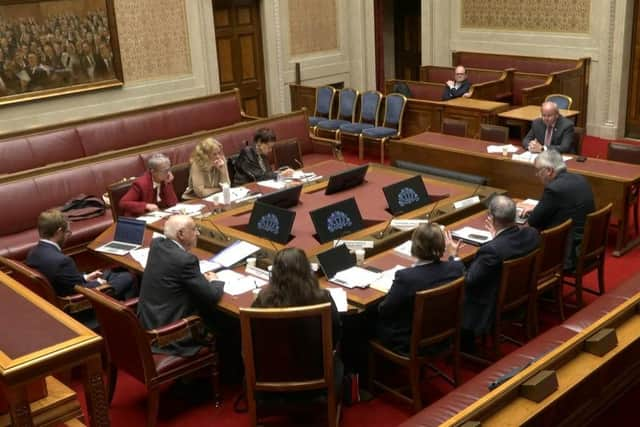

Former first minister Baroness Arlene Foster and her former deputy Lord Dodds joined former UUP and SDLP leaders Lord Elliott and Baroness Ritchie in the Senate chamber to probe current leaders about the deal.
During the session, DUP leader Gavin Robinson warned that a landmark ruling on the definition of a woman was still being frustrated by Stormont departments and public bodies – who are citing Article 2 of the framework.
UUP boss Jon Burrows said the provision undermines the sovereignty of Northern Ireland within the UK – as well as the Good Friday Agreement.
The Northern Ireland Scrutiny Committee is currently conducting an inquiry into that part of the post-Brexit deal.
The provisions were included in what has largely been seen as a trade deal. However, the UK and EU agreed certain equality provisions would be continued on post-Brexit.
A recent Supreme Court ruling clarified the extent to which they provisions apply to local law, after local equality bodies were accused of adopting an “expansionist” approach.
The Equality Commission had argued that its impact could even extend as far as a different legal definition of words like man and woman in Northern Ireland than in the rest of the UK. It is currently asking the courts to clarify such points.
Gavin Robinson told peers that “to this day, government departments in Northern Ireland are either incapable or unwilling to adhere to the out-workings of that Supreme Court decision, because they query whether it can stand in light of Article Two”.
The DUP leader said that while many people may not understand the intricacies of legal arguments around Article 2 – they do care about the principle and the outworking of the Irish Sea border.
He said there is a “genuine understanding of the encroachment on our constitutional position, on feeling less British, on feeling that the rights afforded to us are not the same as those rights afforded to citizens in Scotland, England, or Wales”.
Jon Burrows said the framework had become a “dynamic vehicle upon which you can disapply UK law in Northern Ireland”.
He said: “I think it totally upends the Belfast Agreement because, at its heart, was a principle of consent that Northern Ireland remains part of the United Kingdom until the majority of people say otherwise, and that is not replicated now in legal constitutional reality.
“So not only do we have the separate issue of the trade border, we have a situation whereby laws and directives from the EU can apply in Northern Ireland, be disapplied in Great Britain, and that have no legislative basis or consent from the people of Northern Ireland, or indeed Westminster.
“So it undermines the sovereignty of Northern Ireland in the United Kingdom, which is the cornerstone of the Belfast Agreement.”
Giving his evidence, TUV leader Jim Allister said that along with the rest of the Irish Sea border deal Article 2 is a “constitutional insult” – and removes local and national sovereignty.
The North Antrim MP also said it implied that without the Belfast Agreement and the EU we would have had no rights in Northern Ireland – before citing extensive rights legislation dating back to the 1970s.
Responding to questions from committee chair Lord Carlile, Mr Allister said: “I think it all came about because of the desperation of Boris Johnson to get a deal, any deal, and he was prepared to sacrifice sovereignty in respect of my part of the United Kingdom in order to get that deal.
“And detecting and exploiting his desperation, the EU, as part of their overarching strategy to ultimately thwart Brexit by keeping hold of a part of the United Kingdom, saw this as another opportunity within the Protocol to build upon the suppression of sovereignty and the colonial rule that introduced through Articles 3 to 10 – to build upon that on the issue of rights. I think Article Two was built into that as part of their continuing, in perpetuity, control”.
The TUV leader said the Article 2 part of the deal “doesn’t even have a democratic veneer”. Unlike other parts of the Protocol, there is no Assembly vote on its continuation – “it is a permanent feature”, he said.
He argued that the recent Dillon judgement by the Supreme Court showed that the legislation had a much narrower scope than had been suggested.
“Previously we had a lot of propaganda, not least from the Equality Commission and the Northern Ireland Human Rights Commission, about how Article 2 could be prayed in aid on all sorts of issues. Indeed, the ambition of some was to undermine the other Supreme Court ruling on the Scottish women case, and indeed they were set to do that. I think the Dillon judgment makes clear that there is a much narrower scope”, Mr Allister said.
However, the North Antrim MP warned that it does have direct effect in UK law.
The Alliance Party did not take up an offer to attend the evidence session.
SDLP Opposition leader Matthew O’Toole said the rights part of the deal was “much less controversial” at the time the deal was signed – with the UK government making an early commitment to “no diminution” of rights.
He said the rights contained within the deal are “broad and aspirational” – and there is a question over how enforceable they are.
Asked by the DUP’s Lord Dodds about the democratic deficit created by the deal for everyone in the Assembly, Mr O’Toole said it wasn’t a “diminution of human rights”.
The South Belfast MLA said he didn’t see that as “a more egregious loss of rights” than some of the others he said were lost under Brexit. He also highlighted safeguards put in place under the DUP-Tory Safeguarding the Union deal, while imperfect, were aimed at dealing with that.