
Imminent EU-UK trade deal could soften Irish Sea border - but unionists warn of growing issues over customs
An imminent deal between London and Brussels on food standards could massively reduce the impact of the Irish Sea border, but there have been warnings from unionist politicians that the internal frontier is far from gone.
A draft text has reportedly been agreed between the United Kingdom and the European Union that would see Great Britain align on trade rules on SPS (sanitary and phytosanitary) goods – something Northern Ireland already does under the Windsor Framework.
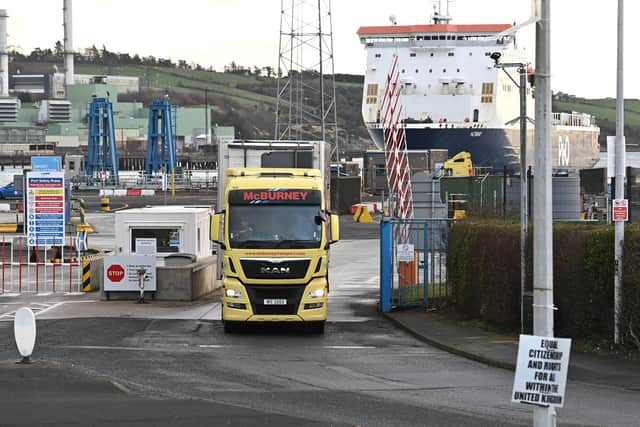

The post-Brexit deal effectively left Northern Ireland in the EU single market for goods, while the rest of the UK left. That meant checks on goods entering the province from Great Britain, in order to protect the European market’s integrity.
The complicated arrangements were set up in order to avoid checks on goods crossing the land border between the UK and the Republic of Ireland. However, they created a physical border within the UK between GB and Northern Ireland.
While the deal had the backing of nationalist parties and Alliance at Stormont, it is opposed by all unionist MLAs.
A major part of the checks relate to food products, but the mooted SPS deal would make them redundant, as Great Britain would be aligned with the EU, and by extension, Northern Ireland.
UUP Windsor Framework spokesperson Steve Aiken MLA has given a cautious welcome to reports of a draft deal, but warned that Northern Ireland remains separated from the rest of the United Kingdom on a wide range of other rules, and says this will get worse under new EU customs law.
“If the agreement goes ahead, checks on most agricultural goods coming from the rest of our nation will be significantly, but not completely, reduced.
“However, Northern Ireland remains separated from the rest of the United Kingdom on a vast swathe of other regulations, tariffs and duties. We remain subject to the EU’s customs code, and with the implementation of the new Union Customs Code, divergence, disruption and distortion of trade to and from the UK internal market will only accelerate”, the South Antrim MLA said.
TUV leader Jim Allister said the government’s plan is “incrementally to effectively take us back into the EU” – and that people in Great Britain would be disenfranchised in the same way people in Northern Ireland had.
“But coming to the Northern Ireland situation, this is a deal to provide a GB-EU SPS agreement. It's not a UK-EU SPS agreement.
“Why is that? Because Northern Ireland has already been captured by the EU. And what it doesn't do, critically, it does not take us out of the customs union.
“Therefore, we still will have the customs declarations, the paperwork attaching to food, and remember, it only attaches to food – there also is the whole panoply of checks about other goods”.
DUP leader Gavin Robinson told the BBC he takes issue with the government’s approach.
“But if this is the approach they want to go down, why do it in a whack-a-mole, single-issue, one-off approach, sector by sector, when, in actual fact, what they should and could be doing is ensuring that Northern Ireland is within the entirety of the United Kingdom when it comes to these negotiations. That we’re not in a separate and distinct structure.
“And if they are being serious about their approach, there’s no justification for keeping us separate and distinct”, the East Belfast MP said.