
Irish leisure centre signs could stop protestants going, Belfast officials warned - one year before politicians decided to blitz the language everywhere
Plastering Irish signs over a leisure centre could stop protestants, unionists and loyalists using it, Belfast officials warned – one year before politicians voted to blitz them everywhere.
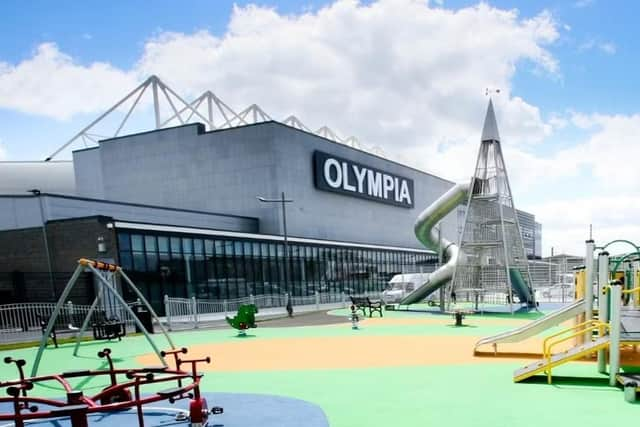
In September 2024, the council reached the end of a years-long battle over whether or not to build Irish language signs at Olympia Leisure Centre on Boucher Road.
A report presented to the council at the time warned of a perception in protestant, unionist and loyalist communities that the signs would stop them going, stating those people were concerned “[Irish] signage may discourage access or use of Olympia by those groups”
The leisure centre is flanked on its north side by Tates Avenue and the Village, a mainly loyalist district – though several parts of the surrounding area are more mixed, including broadly Catholic areas and some containing immigrant communities.

Officials said building Irish signs has the “potential to alienate users from [PUL] communities, making it less likely they would use the centre”.
Though they added that not having bilingual signs may “have an adverse impact on those from the Irish language community”.
Some disabled people, especially those with dyslexia or learning difficulties, thought multilingual signage could cause them to become confused.
Despite the warnings, politicians pushed the Irish signs through – and last week voted to blitz them across every leisure centre in Belfast, including those in deeply unionist and loyalist areas where the language is barely spoken and often opposed.
Consultations carried out as part of equality tests on the Olympia Centre “once more highlighted the deep division of opinion between the two communities” over dual language signs, stated officials.
And they demonstrated conflicts that can arise between different community advocacy groups.
Sandy Row-based Blackstaff Residents Association submitted details of what they said was significant role played by both the Ulster-Scots and English culture in the history of the Olympia area, along with a relative lack of influence of a Celtic culture.
They also handed in a 2,600-strong petition arguing that only adding Irish to the signs excluded not just Ulster-Scots but all the other languages spoken throughout south Belfast, which they argued is “discriminatory, divisive and even offensive”.
But pressure group An Dream Dearg’s rival petition signed by 720 people opposed anything other than Irish, arguing “mitigations” would “dilute” bilingual signs.
Last week Belfast Council voted to blaze Irish language signs across every park, playground, leisure centre and sports pitch in the capital city.
Beginning with a two-year initial phase that will see £1.9m spent reworking prominent parts of the city centre including city hall, plus the west Belfast Gaeltacht quarter, Belfast Castle and Belfast Zoo, the language blitz will eventually be rolled out across the entire city.
The initial phase is also likely to include popular Ormeau Park, located next to the staunchly unionist Willowfield area of east Belfast.
The 100-acre park, also a major concert venue, would be listed as a high priority for signs under the policy as a quarter of people living in a small handful of nearby streets say they have some ability in Irish.
It will also see the council redesign its logo to include the language, something that reportedly has staff who live or work in loyalist areas worried about their safety if the Irish-text version is put on vehicles and uniforms.