
JD Vance free speech debate: Judge to 'reconsider' Supreme Court judgement that Northern Ireland abortion buffer zones are compatible with freedom of expression and religion
A deputy County Court judge is to “reconsider” a Supreme Court judgment that Northern Ireland’s abortion clinic buffer zones are compatible with freedom of expression and religion.
Stormont introduced ‘safe access zones’ of up to 150 metres around eight abortion clinics in 2023.
In December Coleraine Magistrates’ Court convicted Rasharkin woman Claire Brennan of protesting in the Causeway Coast Hospital zone in 2023.
The campaigner had argued that under the European Convention of Human Rights (ECHR) she was entitled to protest due to her right to freedom of religion and expression.

But District Judge Peter King found that a 2022 Supreme Court ruling on the question correctly balanced the rights of pro-life protestors with those of women seeking abortion – and decided that her defence was invalid.
The 53-year-old mother of four describes herself as a Roman Catholic business owner who also helps run a family farm.
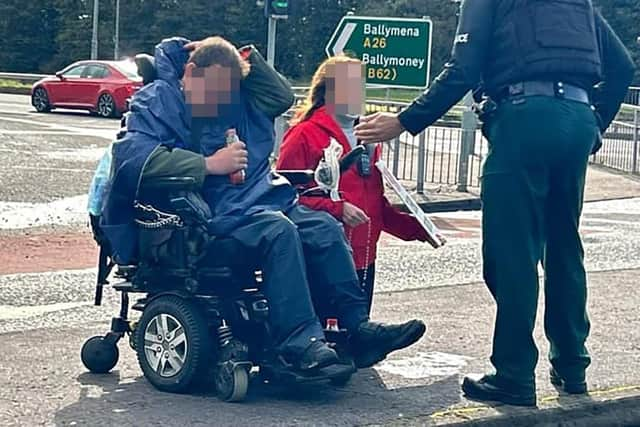
Police told Antrim Appeal Court yesterday that she and fellow protestor with a wheelchair had an eight-by-three-foot sign when arrested, after refusing to leave the Coleraine zone.
But, representing herself in court yesterday, she countered that she was praying silently and had no interaction with any protected person.
Deputy County Court Judge Ciaran Moynagh repeatedly and gently asked her to avoid giving her religious views and to stick to her legal arguments.
Her arrest and conviction, she argued, constituted a disproportionate interference with her rights under the ECHR articles 9, 10 and 11 – freedom of conscience and religion, freedom of expression and freedom of association.
Strasbourg jurisprudence, she argued, requires detailed factual evidence to convict her of a specific criminal offence, and not a blanket application of criminal legislation, especially as it also provides special protections for people engaging in religious and political expression.
“The Supreme Court failed to engage with these enhanced protections,” she said, “especially as I was engaged in a peaceful and non-disruptive protest.”
The ECHR provides “higher protections for religious and political expression” than were acknowledged in the “flawed” Supreme Court judgment, she said, adding that her conviction was therefore incompatible with the ECHR and the Human Rights Act 1998.
She therefore appealed for the judge to “reinstate” her freedom of expression and added: “My freedom to worship in Coleraine hospital chapel is now illegal because it is in the abortion buffer zone.”
She added: “This is an injustice and an undemocratic law.”
However the prosecution responded that the Supreme Court found that the NI Safe Access Zone legislation was not inconsistent with the ECHR and that the protesting offence was not disproportionate.
Under the law it is an offence “to do an act with the intent to influence a protected person in a buffer zone, or be reckless as to whether they might be influenced”, he said.
“The Crown does not have to prove that anyone was impacted.”
Mr Brennan closed by saying that in 13 years of protesting, she has never had a single complaint about causing harassment or distress.
"But I have had women crying in my arms because they have had an abortion and they begged me to give them back their babies,” she added.
The judge said he will now “reconsider” the Supreme Court judgment and deliver his own judgment in the near future.
The issue of abortion clinic buffer zones made international headlines in February when US vice-president JD Vance singled them out for criticism in a speech to the Munich Security Conference, citing freedom of speech concerns.
In April the US State Department publicly voiced support for retired NHS scientist Dr Livia Tossici-Bolt, 64 after she was convicted of protesting in a buffer zone in Bournemouth, Dorset.