
Justice Minister Naomi Long brands UK and Irish government proposals for terror groups 'madness'


Justice Minister Naomi Long has described as ‘madness’ a plan by the UK and Irish governments to appoint an independent figure to assess whether formal engagement with terror groups is needed for them to disband.
The announcement by the two governments came after the Independent Reporting Commission (IRC) recommended a “formal process of group transition, involving direct engagement with the paramilitary groups themselves, in order to bring about their ending”.
In its seventh report, the IRC reiterated its call for the two Governments to appoint an independent person to scope out what a formal process of engagement and group transition might look like. For years it has prompsed deproscription - or decriminalisation - for terror groups that cooperate.
But Justice Minister Naomi Long said she had “no confidence” in the new plans and described them as “madness”.
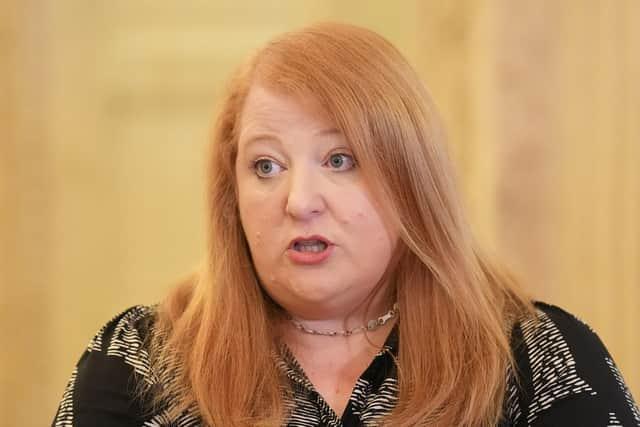
She said: “First of all, despite asking repeatedly, I have not had the IRC or anyone else identify a single credible barrier to these organisations disbanding, or transitioning, if that is what they want to do.
“Secondly, I am unclear when people talk about group transition what they see the end product of that being. When I ask that question nobody can define it for me.”
“I am very clear it is about individuals stopping the harm they are causing in communities and behaving like ordinary citizens,” Ms Long added. Could you imagine the Government engaging in this way with any other criminal gang? It is unthinkable. “I think it is madness. I don’t think it will work because I don’t believe there are barriers to those who wish to stop.” Ms Long said those who are involved in paramilitary groups were only interested in power and money. She added: “I think to have an interlocutor is to suggest at some level there is some conversation to be had. The only conversation to be had with paramilitaries at this point of time is to tell them they need to exit the stage.”
However PSNI Assistant Chief Constable Davy Beck welcomed the IRC report. “Partnership working is an imperative element in our pursuit to tackle this kind of criminality, which we know creates fear in local communities,” he said. “This will not be tolerated and we will continue to ensure that robust enforcement is at the forefront of our approach to dealing with paramilitarism.”
UUP Party Leader Mike Nesbitt also welcomed the proposals, saying he had backed them in discussions with the Northern Ireland Office in 2023. He argued that if inactive and community minded members of terror groups could be separated out, "police could then deal more easily with the criminals".
“This decision by Hilary Benn is the right one, but also a difficult one, given the potential hurt it will cause to those who lost loved ones to terrorist gangs in the past,” he said.
DUP Leader Gavin Robinson MP also backed the proposals.
“It is clear that paramilitaries have no place in our communities,” he said. “Their impact runs deep, with the legacy of the past lingering to this day. Simply wishing they didn't exist hasn't worked.
“Today's initiative, proposed three years ago by the IRC is worth pursuing. The expert appointed should be given the time and space to conduct their work. We can then assess their report in nine months.”
But SDLP Leader Claire Hanna MP has said the time has passed for government engagement with paramilitaries.
“When these proposals were first brought forward by the IRC the SDLP expressed clear opposition,” she said.
“The time for soft transitioning has long since passed, these groups have had multiple opportunities and encouragement to disband over the past 30 years. These are criminal gangs that continue to exert a toxic control over communities across Northern Ireland, and who exploit and perpetuate sectarian division and legacy, and who have continued to recruit members.
She added: “Both governments must learn from the mistakes made in dealing with paramilitary and organised crime groups in the past. Offering further incentives or status to these groups encourages continuing on in the hope of future rewards.”
Kenny Donaldson, director of victims groups SEFF, said that most victims and survivors of the troubles want terror groups to be held accountable for their 30 years of bloodshed - not decriminalised.
"Many will find it incredible that we are in a place where the softly-softly approach continues to be the order of the day in how the authorities deal with terror/'paramilitary' groups," he said.
TUV leader Jim Allister also objected to the proposals.
"So, the Govt is going to appoint a nurse maid to those who use violence and live off criminality,” he said.
"And, as if that wasn’t bad enough, the IRC wants deproscription so that organisations that murdered might be made respectable and continue to exist! When will this pandering ever stop?”