
Ken Bloomfield played a key role in terminating Brian Faulkner's government, wrote a critic of the late civil service chief
Sir Ken Bloomfield had many admirers in his long career as head of the NI civil service and his other public roles and commitments, but he had critics too.
(Click here for pictures of Sir Ken’s funeral, and here for a report about his bravery, and then for a reflection on Sir Ken by the editor click here)
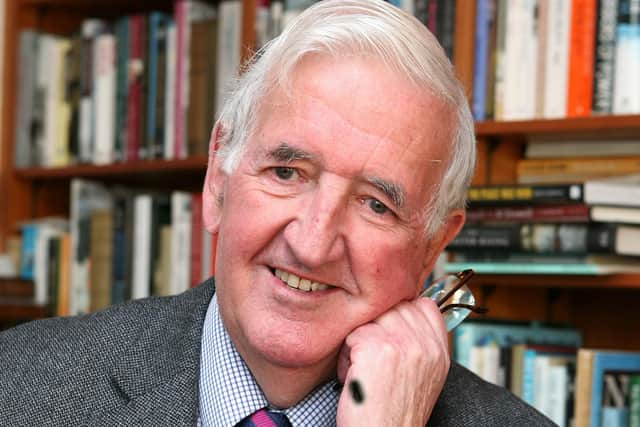

In the autumn of 2020, a civil servant, the late Bill Smith, wrote to this newspaper after we had published an interview with Sir Ken, saying that it had reminded him “of the pivotal role played by the former mandarin in the downfall of the last unionist administration”.
Dr Smith wrote: “As recorded in his memoir, Stormont in Crisis, Bloomfield worked in Prime Minister Brian Faulkner’s office from June 1971 on plans to bring Catholic representatives into the system. These failed when John Hume, supported by Dublin, decided to set up an alternative ‘non-sectarian’ assembly. Violence increased dramatically, and internment was introduced.
“In London, Ted Heath’s Conservative government responded by initiating a fundamental policy review. Faulkner tasked Bloomfield with preparing a programme of deeper reforms to save the established dispensation. Their proposals proved too little too late: on 24 March 1972, Heath prorogued Stormont and Faulkner’s government fell.”
In the letter, which Dr Smith sent to us for publication, he continued: “Bloomfield survived the transition to Direct Rule, and was soon working in a similar capacity for Secretary of State Willie Whitelaw. He revamped his reform proposals, which paved the way for the short-lived powersharing Executive of 1974. At 42, Bloomfield found himself head of the Executive’s Secretariat with the rank of Permanent Secretary. The powersharing experiment collapsed after five months, but by 1984 he was head of the civil service.”
Dr Smith, who has since died, further wrote: “What Bloomfield’s memoir does not record is that part that he played in terminating Faulkner’s government. Papers in the National Archives reveal that Bloomfield secretly visited the UK government’s representative in Belfast, Howard Smith, on 17 December 1971. According to Smith’s record of their conversation, Bloomfield said that ‘Faulkner’s hopes that when (or if) violence was put down the Catholics would come round to cooperation were quite unrealistic’. He argued that Westminster should impose a solution in the form of cross-community government, which must also be acceptable to Dublin.
“Smith passed this on to his masters in Whitehall, adding that Bloomfield ‘… thought such an initiative might lead in the end to the final question of unification; to reveal this intention fully at the outset would be to produce strong Protestant opposition, but … the proposals would eventually be accepted by Protestants if they were imposed without consultation’.
“Smith advised that Bloomfield’s views should be seriously considered in light of his knowledge, ability and experience. Cabinet Secretary Burke Trend then passed them on to the Prime Minister with the comment, ‘… Bloomfield discounts all-party talks and seems now convinced that only an imposed settlement will meet the needs of the situation’.”
Dr Bill Smith’s letter further said: “On 18 January 1972, Home Secretary Reggie Maudling presented the Cabinet with the radical proposal that they should impose a solution on Faulkner.
“Writing about this affair in 2009 (Ringside Seats), Bloomfield’s former colleague Richard Ramsay reasonably asks, ‘What would become of our public service if every administrator took it into his head that he had the right to behave in such a way?’”
Dr Smith’s letter, which was written at a time of change at the top of the civil service, concluded: “We can only hope that the incoming Head of the NICS [Northern Ireland Civil Service] will act with professional integrity.”