
Operation Banner soldiers 'risk being exposed to organised lawfare' thanks to Commons vote says Northern Ireland Veterans Commissioner
The Northern Ireland Veterans Commissioner has said that former soldiers risk being once again "exposed to organised lawfare" as a result of a vote in the House of Commons.
David Johnstone was reacting to the passage of an order repealing both the Troubles immunity measures of the Legacy Act and its bar on new civil lawsuits.
He said that the Labour government's actions show it is "so out of step" with veterans of the Troubles.
His comments were echoed by former soldier and police officer Paul Young, who told the News Letter veterans would be "disgusted, but not surprised" by the repeal move.
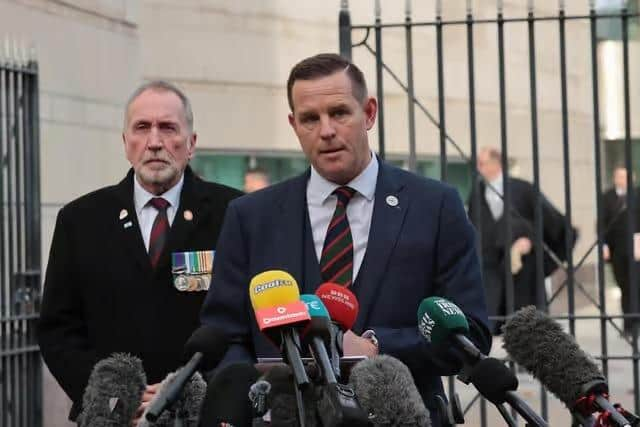

Mr Johnstone said: "It was not a surprise that the Remedial Order was voted through last night, as repeal and replace of the Legacy Act 2023 is Labour Government policy.
"What was surprising was the timing."
However, a UK Government spokesperson said in response: "There never has been and never will be any moral equivalence between our Armed Forces - who laid down their lives for this nation - and terrorist organisations.
"Immunity is a false promise unsuccessfully introduced by the previous Government. It has never been in place due to UK courts finding it incompatible with human rights obligations, resulting in continued legal uncertainty for our veterans.
"We are changing that by putting in place real, workable protections for veterans and we will continue our engagement with their representatives on those measures to ensure they deliver for them."
Mr Johnstone said that the repeal had been "rushed through" on the basis that the current Legacy Act had been ruled unlawful by the Court of Appeal in Belfast, yet that ruling is currently being challenged in the UK Supreme Court (by a group called the Northern Ireland Veterans Movement, in what is known as the Dillon case).
"It is disappointing that the Secretary of State has chosen to simply ignore their legal action and rush through the vote," he said.
"When you add to this the threatened legal action by the SAS Regimental Association regarding the Troubles Bill, it is remarkable the current government finds itself so out of step with those that served on Operation Banner, putting their lives on the line to maintain peace.
"The debate yesterday was passionate and with every NI MP contributing making valid points, it showed the complexity of addressing the legacy question.
"What will be encouraging to veterans is that many speakers across number of parties in the house highlighted the current imbalance of the legacy process to date, one that has delivered early release from prison, royal pardons and letters of comfort for terrorist organisations with absolutely nothing for the security forces.
"If the remedial order passes the Lords veterans will continue to be exposed to organised lawfare through civil claims."
Mr Young, a spokesman for the Northern Ireland Veterans' Movement told the News Letter: "The whole remedial order is a slap in the face to veterans who served in Northern Ireland.
"The Legacy Act actually gave a pathway for the lawfare to cease."
Its removal, and the pending Troubles Bill which will replace it, open the way for prosecutions to resume of soldiers like Dennis Hutchings and Soldier F, he said.
"But what we don't get are terrorists - the people who did the La Mon bombing or Warrenpoint," he said.
"There's just so many but all the focus through all these legacy trials... is on the state, and not on the terrorists where it should be."
Mr Young, now aged 75 and living in Co Down, but originally from Kent, is a former lance corporal who served for seven years with the Blues and Royals, and a former detective sergeant who served for 22 years with the RUC.
When it comes to Labour's rank-and-file's attitudes to the remedial order, he said: "I'm not sure they're completely behind it.
"They're obviously using a three-line whip to get everybody to vote for it.
"We get a lot of feedback from Labour MPs out in the traditional recruiting areas for the military, and they're not really happy with this."
During the debate in the Commons on Wednesday, NI Secretary Hilary Benn had said: “One of the main reasons for the failure of the Legacy Act was its attempt to grant immunity, including to terrorists who murdered, in cold blood, soldiers and civilians in Northern Ireland and in towns and cities across England.
"In fairness, it probably seemed reassuring to veterans, and it was almost certainly reassuring to terrorists who had committed those acts, but it was a false promise that protected no one.
"It was never commenced, which is a very important fact.
"It was rejected by the courts as being incompatible with our legal obligations and, as a result, it was never implemented.
"No one ever got immunity, and while it may remain on the statute book, in practice it does not exist.”
He added that “it was not only a false promise; it created a false equivalence between veterans on the one hand and terrorists on the other”.