
PSNI's new gender pronoun name badges branded "woke nonsense" by DUP Policing Board member Trevor Clarke
A PSNI move allowing officers to add their gender pronouns to name badges has been slammed as “woke nonsense” by a DUP MLA.
Trevor Clarke, a member of oversight body the Policing Board of Northern Ireland, decried the new badges as divisive, arguing that some officers using them and some not could create problems on the force.
Applying pronouns has become a common social media and email tag to, say advocates, show solidarity to transgender and non-binary people.
The idea regularly comes under fire from traditionalists, however, and isn’t universally popular even within transgender and non-binary communities.

It’s not clear what pronouns are to be used on the PSNI’s badges; typically standard online are the likes of “he/him”, “she/her” and “they/them”, though some adopt “neo-gender pronouns” such as “ze/hir” or “xie/xer”.
It’s understood the PSNI is likely to have a list of acceptable pronouns, but it has not been made public.
The badges are voluntary, with serving officers having to request them.
The PSNI say they’ve been brought in as part of the force’s “efforts to become more representative and inclusive, and enable officers and staff to feel supported”.

Said a spokeswoman: "Pronouns can be a small but important way to acknowledge and respect someone’s identity. “The decision as to whether any officer includes pronouns on their name badge will be for that individual to consider. “It is a matter of choice for the individual. Officers and staff who do not wish to have pronouns on their name badge will not be in any way required to have them added and this will be a completely voluntary option.”
The move has been suggested since last year, but the police brought in the new badges in September.
For the DUP’s Trevor Clarke, the “whole thing is nonsense, and most people will see it for what it is”.
He told the BBC’s Stephen Nolan show: “When most people interact with the police, they’re more concerned with the crime they’re visiting them for – not their pronouns.
"Where does it end? What other minority groups will want include on their badges as well?”
Bringing up a hypothetical idea of Christian officers emblazoning their faith on their name badges, Mr Clarke said: “Go down this road, you’re opening the floodgates, you’re causing division amongst the force that’s not necessary.
"Just the name, plain and simple, was sufficient for most.”
Vincent Creelan, a former officer who set up the province’s first Gay Police Association, denied that the badges would be divisive and argued that they’re the force “recognising diversity” that might “make a difference you don’t know about, with an individual in a community about how they respect the police”.
"The police is going into a recruitment process,” he said. “I know they’re going into a lot of minority communities, talking about a better police service is a more diverse police service, and this is a small, almost insignificant, way of doing it.
"This isn’t going to prevent an officer from doing their job or a member of public from getting a service from the police.”
It’s understood the issue is likely to be raised at a Policing Board meeting on Thursday.
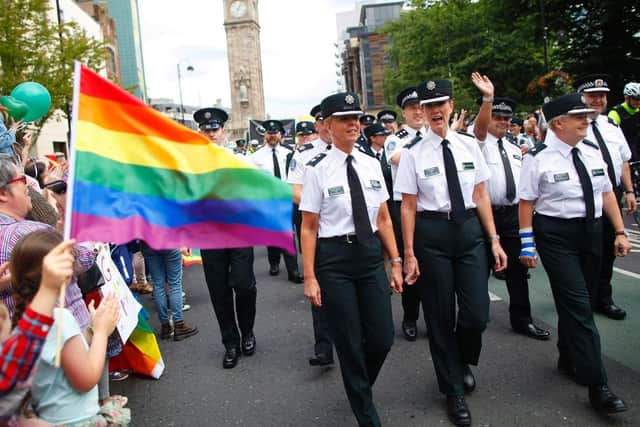
Last year there was anger from the police’s LGBT members after a decision to ban them from marching in uniform at Pride.