
Scottish group behind landmark women's rights judgement says it's 'unconscionable' that NI 'sisters' would be at legal disadvantage
A women’s rights group that took the Scottish government to court and won over how women are defined in law, says women in Northern Ireland must not be left behind because of the Windsor Framework.
Marion Calder – the co-director of For Women Scotland – said that politicians need to “react speedily and remedy” potential issues arising from the post-Brexit deal.
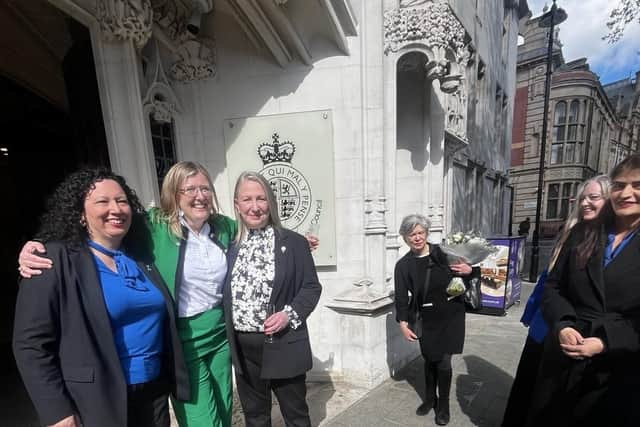

She said it is “unconscionable” that women here could be “at a legal disadvantage compared to their sisters in another part of the country”.
She was reacting to concerns that a UK Supreme Court judgment – which said that sex under the GB Equality Act means biological sex – would not fully apply to Northern Ireland because of EU rights provisions under the deal.
Northern Ireland is required to “keep pace” with certain EU equality directives – including on gender discrimination.
That means compliance with current and future case-law from the Court of Justice of the European Union – which the UK as a whole is no longer a member of.
That could result in a clash between the Supreme Court ruling and the EU court in certain areas – particularly in relation to employment law and gender discrimination law.
However, feminist campaigner Maya Forstater of Sex Matters said that the principle behind the ruling will also apply to the relevant legislation relating to men and women in Northern Ireland.
The Executive Director of the campaign group said: “Just as King Canute recognised that he didn’t have the power to command the tides, the Supreme Court has recognised that no government has the power to legislate humans out of being mammals who come in two immutable sexes”.
She said that although the Supreme Court’s judgment concerned only the Equality Act in GB, it said that the effect of the Gender Recognition Act on the many other statutes that refer to men and women must be carefully considered.
“We are confident that this exercise would result in the same conclusion as in the Supreme Court judgment, when carried out in respect of the meaning of ‘sex’ in relation to the Sex Discrimination (NI) Order 1976.
“Equality between women and men remains a fundamental principle under Article 2 and Article 3(2) of the EC Treaty and in the case law of the Court of Justice. Neither judges in Strasbourg or bureaucrats in Brussels have the power to hold back the tides or to decree that human beings aren’t mammals”.
Stormont’s finance department said it will consider the implications of the ruling “in terms of gender recognition”.
The DUP said the government must ensure that the “common sense” ruling applies to all of the UK, including Northern Ireland, while the Ulster Unionists said the UK Supreme Court has primacy here – and its findings will “influence how services are provided”.
But the TUV said the issue demonstrates that in important areas of law the supreme court in Northern Ireland “is not the UK Supreme Court but a foreign court”.
Asked about the potential impact of the protocol on the ruling, the Equality Commission said it is considering “any potential implications that may arise in relation to Article 2 of the Windsor Framework”.
However, last year, a report by the Equality Commission (ECNI) into the impact of the Windsor Framework in Northern Ireland said that Articles 2 and 13 “require the law in NI to keep pace with any improvements to minimum standards of equality protection” enshrined in EU laws listed in the document.
The public body, responsible for upholding rights laws under the protocol, said: “This includes the EU equality directives which protect against gender discrimination and which cover employment and vocational training, access to goods and services, and social security and protect against gender discrimination including transgender people.
“The obligation also requires compliance with current and future CJEU case-law. The CJEU has made it clear that ‘to tolerate such discrimination would be tantamount, as regards such a person, to a failure to respect the dignity and freedom to which he or she is entitled, and which the Court has a duty to safeguard’.”
The ECNI report said that “NI equality law must keep pace with any enhancements made by the EU to the six Annex 1 directives, on or after January 1 2021, including monitoring current and future CJEU case law”.
Ulster Unionist Justice spokesperson Doug Beattie MC MLA said: “The supreme court ruling was in relation to the Equality Act (2010) which does not apply here in Northern Ireland. We have our own raft of equality legislation however, the Supreme Court does have primacy, and its findings will influence how services are provided in Northern Ireland, from policing and justice to health and communities.
“The simple fact is that a gender recognition certificate will no longer identify your sex, not that it ever did, but it will identify the gender you are as per the regulations laid out in issuing a gender recognition certificate.
“It might be that this will be settled in courts once again, but it is certainly an issue we must deal with at pace because a GRC should not allow you to change your sex on a birth certificate and movement outside Northern Ireland throughout the United Kingdom may well become an issue if we retain differing rules.”
A TUV spokesperson said the party has expressed concern about the impact of Article 2 in the past.
“While its impact on yesterday’s judgment is something we will seek advice on, what cannot be disputed is that in important areas of law the Supreme Court in Northern Ireland is not the UK Supreme Court but a foreign court which adjudicates on laws which to which the people of Northern Ireland have no input.
“This exposes the nonsense that the Irish Sea border is just about trade. It is about placing Northern Ireland in a separate political community from the UK for many crucial purposes. The Protocol brought very far reaching constitutional change imposed without any consent from the people of Northern Ireland,” they said.
DUP South Down MLA Diane Forsythe said: “The UK Supreme Court’s ruling is a victory for common sense, confirming that ‘sex’ in law means biological sex.
“This provides much-needed clarity and protects the integrity of single-sex spaces and women’s rights. The decision reflects the reality understood by the vast majority of the public. It should apply UK-wide, including in Northern Ireland. The government must ensure this principle is upheld consistently across all parts of the United Kingdom so that women-only spaces are protected.”