
First polls close in the American presidential election, as most of the country continues to cast a vote
The first polls in America have closed in an intensely fought presidential election.
The incumbent US vice president Kamala Harris, the Democratic Party candidate, was narrowly ahead of her Republican Party challenger, the former president Donald Trump, in late surveys before polling day.
As the print edition of this newspaper prepares to go to the press coming up to midnight UK time, 7pm Eastern Time, most of even that easternmost time zone is still voting, as is all of the most westerly time zones. Only some polling stations on parts of the Atlantic coast have just closed (at 6pm Eastern Time, 11pm UK time).
The result could be largely known by 9pm Eastern Time, 2am, if it is a decisive one, with one candidate well ahead. Or it might be that it remains undecided until long after the polls close in Hawaii at 7pm local time, 5am UK. It could in fact remain undecided for days or even weeks, as happened in the year 2000 when George Bush’s disputed victory over Al Gore all came down to a few thousand ballots in the state of Florida.

One thing has been clear for years, and will remain the case even if one or other candidate wins decisively: the country is bitterly divided, with many disliking either Mrs Harris or Mr Trump intensely and many others unimpressed by both.
The News Letter has been reporting from the safe Democratic Party state of California, and its neighbouring states of Nevada and Arizona, that could go for either Mrs Harris or Mr Trump (Click here to read Ben Lowry’s report from San Francisco, and here to read his report from a Nevada Trump rally and for his report of a Harris Arizona rally click here. His pre poll analysis of the election surveys is found here).
The last presidential election, which Joe Biden won comfortably in a result that Mr Trump and his supporters still do not accept, saw a staggering 160 million Americans go to the polls, some 67% of the US electorate. While such a turnout would be normal in a UK general election, it is far higher than US historic turnouts, which decades ago typically saw only half of Americans cast a vote. The much higher than average turnout in the 2020 presidential race, reflecting the now intense interest in how the country is governed, was in fact higher than the per cent of UK voters who cast a ballot in July’s Westminster election.
More than 82 million people voted early, which is also an unprecedented number, more even than in 2020 which was itself higher than it had ever been before due to the pandemic.
This article is being written from Arizona, in which Mr Trump is the narrow favourite. He won the state over Hillary Clinton in 2016 by a mere 3.5%, but then lost it to Joe Biden four years later by a wafer thin 0.3% (a 10,000 vote majority out of 3.3 million in the state). There are 11 electoral college votes up for grabs in an electoral college that will decide the race – the candidate who gets to 270 such votes out of 538 wins the race.
If the contest is too close to call by Wednesday morning in the east and centre of the US, then the western states of Nevada and Arizona could decide the race. It might even be that the last votes counted in the latter state become kingmakers, in which case the contest could drag on for another 10 days – the length of time it takes to count all Arizona votes. But that is a highly unlikely scenario.
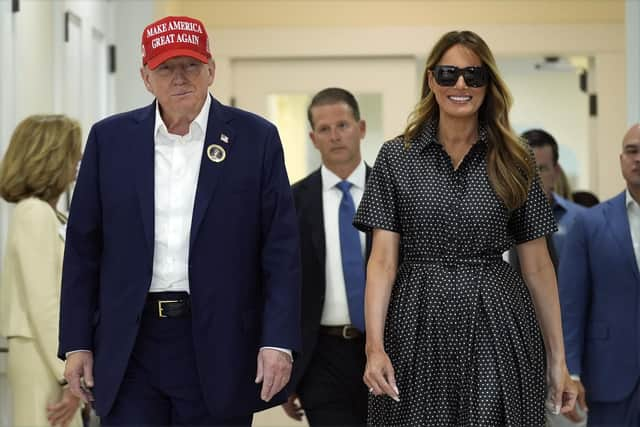
Mr Trump voted in Palm Beach, Florida, near his Mar-a-Lago club, early on Tuesday and said afterwards that he was feeling “very confident”.
“It looks like Republicans have shown up in force,” the 78-year-old told reporters, wearing a red Make America Great Again baseball cap.
Mr Trump said he had not prepared a speech on the results – win or lose – saying: “I’m not a Democrat. I’m able to make a speech on very short notice.”
Ms Harris, the Democratic vice president, did phone interviews with radio stations, then visited Democratic National Committee (DNC) headquarters in Washington carrying a box of Doritos.
“This truly represents the best of who we are,” Ms Harris told a room of cheering staffers.
The 60-year-old candidate stands to be the first female president if elected and has promised to work across the aisle to tackle economic worries and other issues without radically departing from the course set by President Joe Biden.
Mr Trump has vowed to replace thousands of federal workers with loyalists, impose sweeping tariffs on allies and foes alike, and stage the largest deportation operation in US history.
The two candidates spent the waning hours of the campaign overlapping in Pennsylvania, the biggest of the seven battleground states that include Nevada and Arizona. The others are Michigan, Wisconsin, Georgia and North Carolina.
In Scranton, Pennsylvania, Liza Fortt arrived at her polling location in a wheelchair and not feeling well. But she ventured out anyway to vote for Mrs Harris. “It means a lot to me and my grandkids, my granddaughters, my nieces ... I was just waiting for this day to come,” said Ms Fortt, 74.
She said she never thought she would have an opportunity to cast a ballot for a black woman in a presidential race. “I’m proud, to see a woman, not only a woman, but a black woman,” Ms Fortt said.
First-time voter Jasmine Perez, 26, cast her ballot at the Las Vegas Raiders’ stadium in Nevada for Mr Trump. “What really attracted me to Donald Trump is I’m a Christian,” Ms Perez said. “I like that he openly promotes Christianity in America.”
Ben Lowry (@Benlowry2) is News Letter editor