
Booklet marks the 250th anniversary of Declaration of Independence
Earlier this year on the 4th of July, I launched a little booklet to mark the 250th anniversary of the Declaration of Independence.


The booklet called “The 250th anniversary of the Declaration of Independence 1776 – 2026 and the Ulster-Scot John Dunlap who printed it as the Dunlap Broadside”
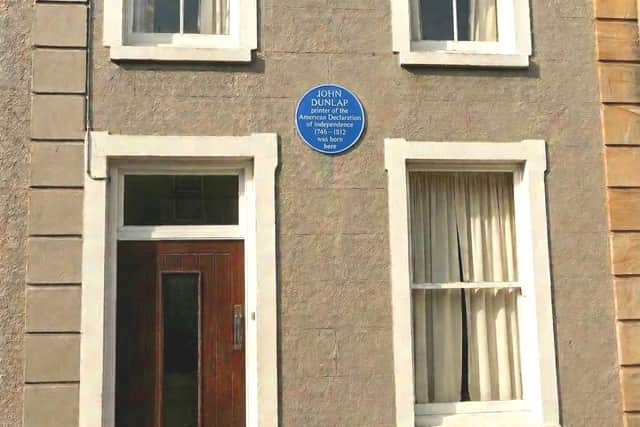
John Dunlap was born at Meetinghouse Street, Strabane, County Tyrone on the 21st August, 1747. The house he was born in at Strabane was still in existence in the 1970s. Sadly and unbelievably it was knocked down, another failure to preserve our great heritage. John Dunlap’s very important life story makes the case once again for a County Tyrone Museum at the unused St. Lucia Barracks in Omagh.

At the age of 8 John Dunlap in 1755 would begin to learn the skills of printing in a booming print industry in Strabane with twelve printing presses in the town including what became Gray’s Printers and this would prove invaluable for him in later life. Gray’s Printers established 1797 is the last one in Strabane and today it is owned by the National Trust and associated with John Dunlap, although it is not known which printers in Strabane he learned his trade. It most certainly was not Gray’s.
When he was still a child aged just 10, in 1757 he immigrated with relatives to Pennsylvania, a colony that had become a major destination for Ulster-Scot settlers.
Among the many figures associated with the birth of the United States, few have left a more tangible mark on history than John Dunlap, the printer whose presses produced the first copies of the Declaration of Independence on the 4th July, 1776.
While the names of statesmen such as Thomas Jefferson, John Adams, and Benjamin Franklin are familiar throughout the world, the man responsible for transforming their words into a document that could be distributed, read, and celebrated across the American colonies is far less widely known.
John Dunlap printed the first Dunlap Broadsides or the initial published copies of the United States Declaration of Independence on the evening of the 4th of July, 1776, and they were delivered to the Continental Congress the following morning, 5th of July, 1776.
Today, surviving copies of the Dunlap Broadside are among the most treasured documents in existence. They stand as an enduring testimony to the craftsmanship of the Ulster-born printer whose work helped spread the message of liberty throughout a new nation.
In the booklet I included the life story of John Dunlap and the full text of the Declaration. It must be unusual to have two blue plaques to the same person in the one town, as a second blue plaque to John Dunlap was unveiled in Strabane earlier this year. I believed the bridge beside were John Dunlap was born and that this year was divisively named after a Sinn Fein Councillor should have been called the John Dunlap Bridge. And that John Dunlap should have a statue in his honour in Strabane as his life was that important in world history. Perhaps we will get the statue.
One thing is for certain on the 250th year or the semiquincentennial of the Declaration of Independence as it is formally known of the USA. The printing of this world changing document is something we as Ulster-Scots can be so proud of. In particular that an Ulsterman from County Tyrone by printing the declaration delivered the birth certificate of a new nation. A nation shaped by Ulster-Scots that has become the world’s only superpower with freedom and liberty at the nation’s heart.
Stevan D. T. Patterson Castlederg