
Ireland’s Forgotten Heroes
This week, the 2026 Poppy Appeal will be launched across the United Kingdom and Commonwealth – marking the start of the national period of commemoration culminating in Remembrance Sunday and Armistice Day. This incredible important campaign offers critical support to veterans and their families, and is the very least we as a society should be doing to honor our brave men and women in uniform.
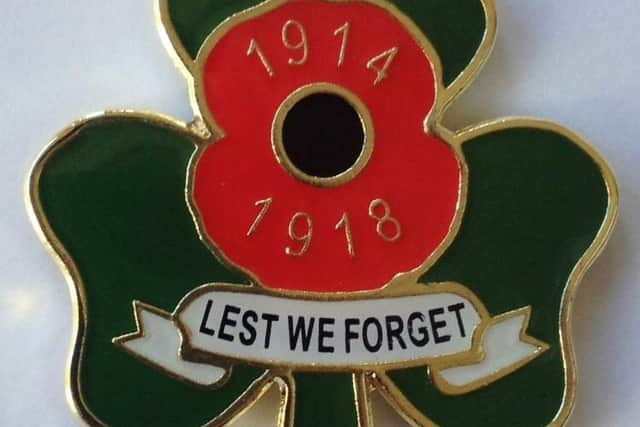

Indeed, the Poppy is quite a small act of remembrance (albeit a powerful one). Inspired by the Canadian Military Physician Lt Col John McCrae’s poem “In Flanders Field” depicting the growth of poppies growing over old battlefields, this small pin adorns our clothing for only a few weeks every year since 1921.
To this end, it is all the more important that the campaign each year is fully embraced. From the UK, to Canada, to Australia, nations will come together to salute the service and sacrifice of our Armed Forces.
It is important to mention that there have been important steps taken by recent Taoisigh Michael Martin and Leo Varadkar (Heirs to the parties of De Valera and Collins) to don the Shamrock Poppy and pay homage to the forgotten of Irish history. That is those Irish men and women who served in the British Armed Forces, and who did so proudly.
On the battlefields of the First World War, 200,000 Irish men served in Britain’s armed forces – with between 30,000 and 50,000 making up the ultimate sacrifice. Their service has always been juxtaposed with the 1916 Rising, as if invalidating the bravery of these men for not conforming to a particular movement’s version of history.
In the Second World War, approximately 80,000 Irish men took up the fight against the Nazi tyranny – with 5,000 going so far as to deserted the neutral Irish Free State to join the fray. For this action, they were subjected to a state-sanction campaign of ostracization for the crime of opposing Hitler.
An Irishman, Eoin McGonigal, was one of the founding members of the SAS alongside his close friend, Ulsterman Lt Col Paddy Mayne.
The Irish Guards – formed in 1900 by Queen Victoria in recognition of the bravery shown by Irish soldiers in the Second Boer War – deployed and fought in the wars in Afghanistan and Iraq during this century.
Hundreds, if not thousands, from Ireland or with Irish heritage presently serve in the British Armed Forces with distinction.
Like it or not, there is a long and unbroken tradition of Irish men and women serving with distinction in the British Army – dating back even before Poppy Appeal was established.
Indeed, amongst the prominent alumni of my school (Castleknock College) was Lt Col James Henry Reynolds – a field surgeon who served bravely during the Anglo-Zulu War and for which he received the Victoria Cross for his actions at the Battle of Rorke’s Drift (memorably depicted fellow Irishman Patrick Magee in the 1964 classic film – “Zulu”).
Yet, there are many who would still wish to keep the Poppy a controversial symbol in Ireland and conveniently erase this integral part of our history. There are those who try misrepresent the Poppy as a symbol of colonial butchery or who are happy to burn Poppy wreaths on bonfires. There are those who would denigrate the service and sacrifice of these brave men and women. Their narrative is one where any Irish serviceman was either a sell-out or a victim of economic circumstance. Sadly, their efforts have been successful as it has taken almost a century to even acknowledge our fellow countrymen. Such efforts and narratives are nothing more than attempts to ignore the truths of history and assure oneself of purity.
Almost a century on from the launch of the Poppy, the wearing of a Shamrock Poppy by the Leader of Ireland is being debated. Meanwhile, in Fairview Park in Dublin, a statue stands honoring Sean Russell, an IRA leader who collaborated with the Nazis and died a German U-Boat transporting him back to Ireland to carry out the next phase of his mission. Go figure.
As we speak, countless sons and daughters of Ireland serve in the British armed forces safeguarding Ireland’s security without any recognition by their government. Some things never change. At the very least, we as a nation should be able to gather and honor their service. At the very least.