
Northern Ireland urged to address disparity in newborn screening for spinal muscular atrophy
Families in Northern Ireland risk being left behind as other parts of the UK move forward with newborn screening for spinal muscular atrophy (SMA), amid calls for greater consistency in access to early diagnosis.
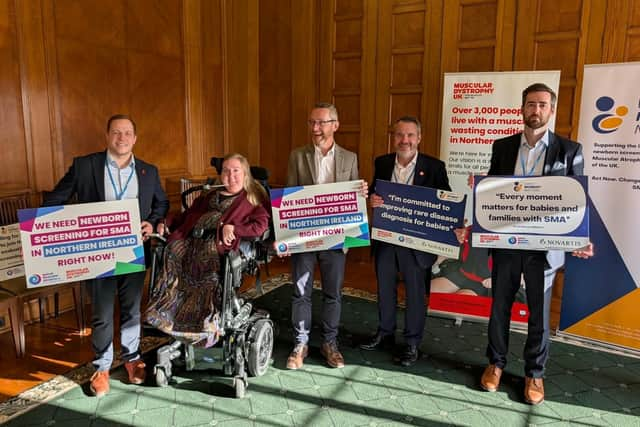

The issue was highlighted at an event in the Northern Ireland Assembly on Monday 2nd November, sponsored by Danny Donnelly MLA, Deputy Chair of the Committee for Health and a registered nurse.
The event brought together policymakers and members of the SMA community to discuss the importance of early diagnosis and the differences emerging in newborn screening provision across the UK. It was organised and funded by Novartis Pharmaceuticals UK Ltd.
Newborn screening for SMA is now being introduced in England through an in-service evaluation, following the recent introduction of screening in Scotland. The Republic of Ireland also began screening for SMA earlier this year. However, babies born in Northern Ireland and Wales do not currently have the same opportunity for SMA to be identified through newborn screening.
SMA is a rare genetic condition that causes progressive muscle weakness. Earlier diagnosis through newborn screening can help identify the condition before symptoms develop, enabling families and clinicians to act sooner.
Danny Donnelly MLA said:
“Every baby born in Northern Ireland should have the same opportunity for an early diagnosis of spinal muscular atrophy, regardless of where they are born in the UK. Newborn screening can help identify SMA before symptoms develop, giving families and clinicians the opportunity to act earlier.
“As a registered nurse, I know how important early diagnosis can be for children and their families. I’m pleased to support this event at the Northern Ireland Assembly and to hear directly from families about their experiences. We need to ensure families in Northern Ireland aren’t excluded as other parts of the UK progress with introducing newborn screening programmes for SMA, and must continue the conversation about how we can address this disparity.”
The issue has also gained attention at Westminster. The MP for Strangford recently highlighted the position facing families in Northern Ireland during a debate on SMA and called for the evaluation framework to be extended.
Mr Donnelly said the issue also links to Northern Ireland’s wider ambitions for people living with rare diseases, including commitments within the Rare Disease Action Plan.
He added:
“Families in Northern Ireland should not have to face a different pathway to an SMA diagnosis simply because of where their baby is born. With newborn screening now being introduced in England and already available in Scotland and the Republic of Ireland, there is an important conversation to be had about the disparities emerging in Northern Ireland and Wales.
I’m proud to support this event at the Assembly and to bring greater attention to the experiences of families affected by SMA. As a nurse, I understand the importance of early diagnosis, and I hope this discussion can help build momentum towards greater consistency in newborn screening access across the UK.”
Andy Fletcher, Chief Executive of Muscular Dystrophy UK, said newborn screening offered the “fastest and most effective route” to an SMA diagnosis and argued that families should have equitable access regardless of where they live.
“Every baby deserves the same chance of early diagnosis and early treatment, and it’s simply not acceptable that a postcode lottery exists. We urgently need a commitment from the Northern Ireland government to start newborn screening for SMA and, together with our partners and the SMA community, we’re committed to continuing our campaigning to ensure equity across the UK. With a muscle wasting condition like SMA, time is everything. And every baby matters.”
The Assembly event sought to bring greater attention to the experiences of families affected by SMA in Northern Ireland and contribute to discussion about how the current disparity in newborn screening might be addressed.