
Windsor Framework: Unionists MLAs band together to trigger Stormont Brake in bid to scupper new EU rules on chemicals in latest fallout from Brexit
Unionist parties in Stormont have agreed to come together to jointly trigger the Stormont Brake for the first time.
Pulling the brake basically invites the UK government to veto a new EU rule, if that rule will have a big negative impact on Northern Ireland.
It needs 30 MLAs – who cannot all be from the same party – to sign up before it can be activated.
In this case, the News Letter has been told that the DUP (with 25 MLAs) can count on the support of the UUP (nine MLAs) and TUV (one MLA) to get it over the threshold.
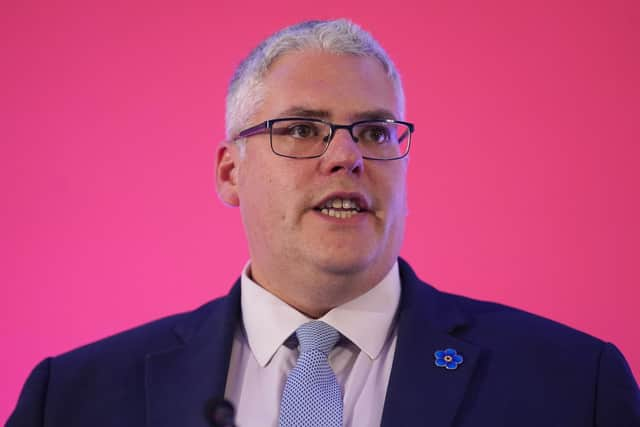

What has sparked their objections is a pending new EU regulation on chemical packaging.
Announcing the intention to pull the brake, the DUP leader Gavin Robinson said in a statement: “The DUP is focused on fully restoring Northern Ireland’s place in the United Kingdom and its internal market.
"We have made no secret of the fact that we will use the Stormont Brake to full effect in the pursuit of our overall objectives.
This EU regulation introduces a host of new requirements for labels attached to chemical products, including new minimum font sizes and rules around spacing.
"This would make current labels unusable for the majority of products. Critically, these changes would not be required for products on the market in Great Britain.
“With trade flows in chemicals between Great Britain and Northern Ireland worth in the region of £1bn annually, the impact of this divergence would be significant.
"The Chemical Industries Association (CIA), which represents chemical and pharmaceutical companies across the UK, has assessed that the regulation would have a significant, negative and prolonged impact on everyday life in Northern Ireland.
“Applying this law under the Windsor Framework would represent a further fracture in the UK internal market, driving up costs for manufacturers and creating a chill factor for GB-based companies currently supplying the NI market.”
The Stormont Brake was part of the Windsor Framework, agreed in February 2023, which amended the NI Protocol.
Triggering the brake does not, in itself, stop anything.
Rather, it grants the UK government the power to tell the EU that it will not implement certain new rules.
The brake can only be pulled in cases involving “new or amended EU goods rules that would have a significant impact on the day-to-day lives of businesses and citizens” said the government in its 2023 command paper announcing the deal.
It added: “The brake will not be available for trivial reasons. There must be something ‘significantly’ different about a new rule, whether in its content or scope, and MLAs will need to show that the rule has a ‘significant impact specific to everyday life’ that is liable to persist.”
MLAs pulling the brake must show it is being done in “the most exceptional circumstances and as a last resort, having used every other available mechanism”, says the NI Assembly.
Last year, DUP MP Sammy Wilson had said the Stormont Brake “will have to be used on lots of occasions,” even though “I suspect it’d be fairly ineffective”.
In an interview with Times Radio, he said “the Stormont Brake is not really a brake at all” because it “will depend on the willingness of the UK government to act”.
If the government did decide to veto a new EU law, then the EU could then take “retaliatory action” said Mr Wilson, adding: “That’s the flaw in the Stormont Brake. It was meant to give control and say over EU laws in Northern Ireland to Northern Ireland representatives.
"Actually the final decision on this will be made by the UK government – which will always know that there’s consequences for trying to stop EU law continuing to apply in Northern Ireland.”
Last year, the then-Northern Ireland Secretary James Cleverly had said that, if the brake is pulled, “the UK government is duty-bound to take it very seriously, in a political sense,” adding: “If this was triggered, it is inconceivable that the British government would ignore it.”