
Extremely rare Hoopoe bird spotted in Comber
Bird-watchers have been travelling from far and wide to see the African bird bizarrely seen in Co Down
A rare bird normally found in Africa or Asia has been captured on video by Castle Espie’s eagle-eyed reserve manager.
The exotic looking Hoopoe had its crown of feathers tucked back when it was hunting for food at a Comber farm on Wednesday morning, far away from its usual habitat, to the astonishment of twitchers.
Castle Espie manager Maurice Turley said spotting the pinkish bird with black and white wings was “great”.
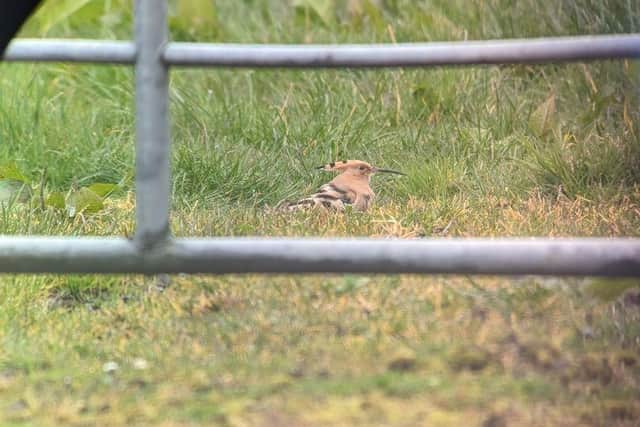

He added: “A rare Hoopoe was spotted close to Castle Espie in the North Strangford area.
“Hoopoes do not breed here, but they can sometimes be blown off course during their spring migration between Africa and southern Europe.
“It is great to see this exotic looking bird, with its distinctive crest in the locality, and seems to be staying around and happily feeding.
“Every now and then, we get a rare bird showing up, usually during times of high migration and they are a welcome addition to our important native fauna.
“Strangford is an extremely important area for migrating birds, with tens of thousands relying on the habitats of Strangford Lough along their migration routes.”
The Hoopoe is also known by “Upupa epops”.
‘Upupa’ and ‘epops’ are the Latin and Ancient Greek names for this species.
Hoopoes are a regular passage migrant to the UK, usually during spring and autumn, with approximately 100 birds visiting each year.
They are usually seen along the south and east coasts of England, but can appear anywhere.
An exotic looking bird that is the size of a mistle thrush, it weighs from 47 to 87g.
The Hoopoe has has a pinkish-brown body, measuring 26 – 28 cm in length.
It has striking black and white striped wings measuring a wingspan of 42 – 46cm.
When in flight, the wings are broad and rounded.
The tail is black with a broad white band.
Juveniles are duller with off-white wing bars.
The Hoopoe also has a long pinkish-brown crest which it raises when excited, and when landing the crest is usually raised into a fan-shape for a brief moment.