
Carla Lockhart speaks out against 'undercurrent of anti-white racism' as MPs debate Henry Nowak murder
DUP MPs have spoken out about the murder of Henry Nowak, with Carla Lockhart pointing to a growing “undercurrent of anti-white racism” in the UK.
She was joined in her denunciation of the murder and the police response by party colleague Sammy Wilson.
They were among dozens of MPs speaking on the topic in the House of Commons.
Mr Nowak, an 18-year-old white British student of Polish extraction, was stabbed to death by a British Sikh man, Vickrum Digwa, with a ceremonial Sikh knife in Southampton in December 2025.

Digwa told police at the scene that Mr Nowak had used a racial slur, attacked him, and removed his Sikh turban (claims for which there is no evidence, and which a judge dismissed as untrue).
The officers arrested Mr Nowak as he lay on the ground despite his complaints that he had been stabbed and could not breathe, leading many commentators to say that the police seemed more concerned with the allegation of racism than the welfare of the dying student.
Rioting broke out in Southampton last night after the release of police bodycam footage.
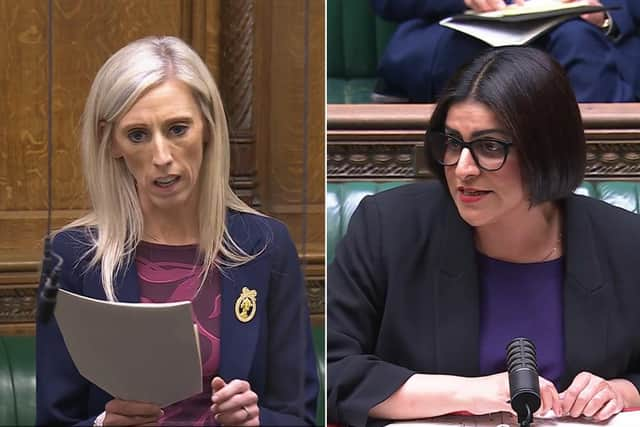
Upper Bann MP Mrs Lockhart told the Commons the case had brought her to tears, adding yesterday: “It appears that we have an undercurrent of anti-white racism brewing in the UK.
"We see white people jailed for allegedly inciting racial hatred on social media, while members of other communities are not even prosecuted for viciously attacking police officers.
"Henry Nowak deserved better – he did not deserve to be attacked; he did not deserve to spend his final moments pleading for help and saying that he could not breathe; he did not deserve not to be believed; and, above all, he did not deserve to die.
"Why did it take this government until yesterday to speak out on this matter, while they run to virtue signal on many other cases?
"Is the UK no longer a safe place for people like Henry Nowak?”
The home secretary, Shabana Mahmood, said: “The reason the government did not comment until yesterday is because a criminal case was going through our courts.
"Members of this House, and certainly members of the government, are not commentators for the purposes of social media.”
East Antrim MP Mr Wilson said: “How have we reached a stage in this country where, when the police go to an incident, they arrest a dying man because they are afraid of being accused of racism by his murderer?
"This is affecting the police right across the United Kingdom.”
He made reference to an incident in Hazelbank Park in Newtownabbey several days earlier, when Asian men in ceremonial dress were filmed dancing and carrying knives.
"No arrests were made, excuses were made for carrying the weapons, and the anger of the community is palpable,” said Mr Wilson.
"Would the Secretary of State make it clear to the police that policing should not be based on fear of racism, or direction by chief constables, or on the colour of people’s skin?
"The police should carry out their duty impartially; two-tier policing only diminishes the police and undermines their credibility and their standing in the community, which is bad for everybody.”
To this, Ms Mahmood replied: “There can, of course, be no suggestion of two-tier policing; we would never – no one would ever – stand for that.
"I hope the right honourable gentleman will acknowledge that the police respond to danger every single day and have to make quick decisions, usually in very difficult circumstances.
"In the vast majority of cases they do get things right, and it is important that we acknowledge that broader picture of policing.
"Of course, when things go wrong or the balance is not struck correctly, that should be investigated and scrutinised, and lessons must always be learned.
"I would not want us to be in a position where we just accept that there are big problems with how our police, generally speaking, approach their job.
"I do agree that any instances where it looks as though something has gone wrong cost public confidence in policing, but that is why we have the independent arrangements with the IOPC to investigate fully and make findings of fact, on which the government and others can take action.”