
European human rights law invoked to free on-the-run killer Gary Anderson - MP dubs decision a 'travesty' that leaves parties involved looking 'foolish'
Northern Ireland’s top judge has moved to explain why a court overturned a decision to refuse temporary compassionate release to a convicted murderer who has now gone on the run.
The news comes amid ongoing controversy around the disappearance of Maghaberry prisoner Gary Anderson, who fled while out on compassionate temporary release (CTR) on Monday, possibly to the Republic of Ireland.
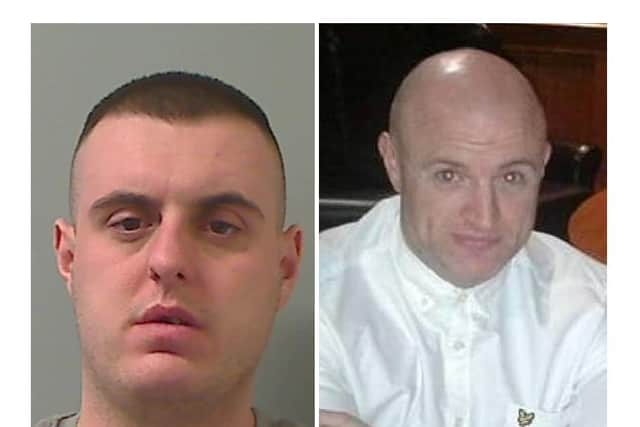

It has emerged that Anderson’s legal team had argued that the Prison Service’s refusal to release him was a breach of the European Convention on Human Rights (ECHR).
Jim Allister KC has called the case a “travesty,” and said this is another example of the ECHR being used to “prioritise the lawbreaker over victims”.
Meanwhile further details have been confirmed of the release conditions which were imposed on Anderson (see right).
Anderson was serving a 15-year sentence, imposed in 2023, for the 2018 murder of Karol Kelly, a man who had been stabbed to death in a Londonderry street after a dispute.
Anderson’s brother Sean got 17 years for the same murder.
Their father died on Friday, and the brothers applied to the Prison Service to be released for his funeral on Monday – an application that was refused.
The brothers challenged this in court, and judge Mr Justice Rooney in the High Court ordered that Sean be kept inside, but that Gary could be released.
Here is how the Lady Chief Justice’s office, representing the judiciary, has described it: “On Sunday September 13, 2026, the court heard an application for leave to challenge the decisions of the governors of Maghaberry and Magilligan prisons to refuse to release Gary and Sean Anderson (respectively) on compassionate temporary release (CTR) to attend their father’s funeral.
"The application was brought on the grounds that the decisions breached the ECHR rights of the applicants.
"The court found that the decision by the governor in respect of Sean Anderson was carried out lawfully and refused the application for leave to challenge the decision.
"In the case of Gary Anderson, the court held that the governor’s decision not to grant CTR was not substantiated by the evidence which was provided to the court.
"It granted the application for leave to challenge the governor’s decision and issued an order of mandamus requiring the release of Gary Anderson on CTR with conditions attached.
"This was an individual judicial decision, and it is not appropriate for this office to make any further comment.”
TUV leader Mr Allister MP has told the News Letter: “Once more slavishly subservience to the ECHR has prioritised the lawbreaker over victims and the safety of the public.
“Both the court and the Prison Service are left looking foolish when one brother is rightly kept in custody and the other is not.
"Looking in from the outside this is incongruous.
“Public confidence in the system is hard to sustain when faced with such a travesty as has unfolded here.”
UUP peer Lord Empey said that the ECHR has gone on to be “abused” by criminals since it was first published in 1950.
Brexit did not effect the UK’s adherence to the ECHR, which in any case has been largely written into UK law via the Human Rights Act 1998.
Doug Beattie, who has long been critical of prisoners being allowed to go on-the-run, said court decisions are being made “that many victims struggle to understand”, and that “public confidence is now dangerously low... it is time we started taking justice seriously again”.
The murder for which the Anderson brothers were convicted happened on March 4, 2018.
On that date, the two brothers were drinking in the living room of their terraced house in Grafton Street in Londonderry when unexpectedly at about 2am two men – one of whom was Karol Kelly, aged 35 – came into the house and attacked the Anderson brothers.
A previous court had ruled: “The reason for this attack is unclear save some reference is made to the fact that it may have been due to the deceased’s belief that a relative of his had been badly assaulted by the two brothers a week or so earlier at a football match.”
The two men were then chased down the street by the Anderson brothers.
Mr Kelly was caught, beaten, and stabbed at least three times.
The Anderson brothers denied murder, but were convicted by a jury.
During a failed attempt by the brothers to reduce their sentences last year, a court heard that Sean posed “a significant risk of serious harm”, and Gary had been assessed as being of “medium likelihood of reoffending, but he has not been assessed to be a significant risk of serious harm”.
The court was told he had accepted his life in prison, had achieved enhanced prisoner status, and had a position as a prison orderly.