
MPs attack lack of political support for police recruitment – but decline to name any party
A report by MPs has criticised a lack of unanimous political support from for those seeking careers in the PSNI – but has declined to name any party.
It is the second time in a week that a lack of political support for the PSNI has been attacked without stating who the alleged culprits are.
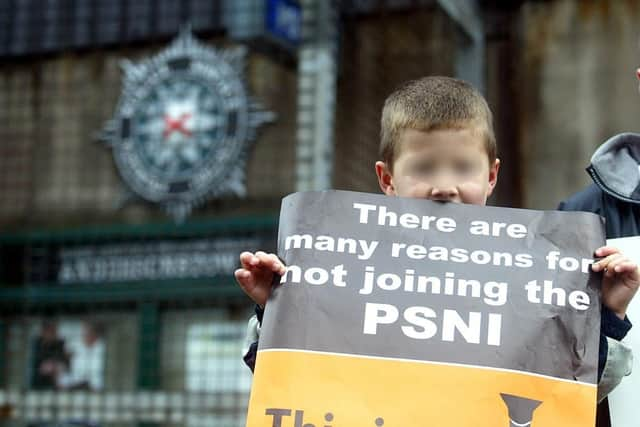

Last week the head of the Police Federation in Northern Ireland Liam Kelly had complained in a speech of “half-hearted” backing for the force from some quarters, but declined to name any party.
Now a report from the Northern Ireland Affairs Committee at Westminster has done much the same.
The report – titled Policing and security in Northern Ireland – is into the general state of the PSNI, 25 years after it was founded. It is published today.
The committee which authored it is chaired by Labour MP Tonia Antoniazzi, and includes DUP MP Gavin Robinson, SDLP MP Claire Hanna, Alliance MP Sorcha Eastwood, and UUP MP Robin Swann, as well as Tories and Lib Dems.
It criticises a lack of Catholics in the force, and says there are not enough ethnic minorities and working class people in its ranks.
In the section looking at the make-up of the PSNI, it has a segment titled ‘Support for policing from political parties and civil society’.
This states: “Encouraging representative recruitment is not just a policing responsibility.
"Some felt that political parties and civil society leaders could also do more to offer visible and vocal support for policing in Northern Ireland and encourage policing as a career option to their constituents.”
The section includes a quote from the 1999 Patten Report, which said that parties “should take steps to remove all discouragements to members of their communities applying to join the police, and make it a priority to encourage them to apply”.
The report then goes on to quote erstwhile Policing Board chairman Mukesh Sharma as saying “that is not happening… there are some political parties that will and others that do not, and that is frustrating and very disappointing”.
The report then quotes the Chief Constable as saying that “not all political parties have come in to support policing in the way that I think the Patten commission envisaged”.
The report’s authors then conclude: “Vocal support for policing and careers in the PSNI from political and civil society leaders has not been consistent from all communities in Northern Ireland.”
A week earlier, at the Police Federation annual meeting, Liam Kelly had attacked the “indifferent political approach taken by some parties” to police recruitment, adding “it’s time everyone did their bit in a more vocal and assertive way to promote a career in policing” and that it is time to “end half-hearted support for policing”.
While he cited “nationalist politicians” as needing to be vocal, he too did not name any party.
The NI Affairs Committee’s report, when looking at Catholic recruitment, notes that the proportion of Catholics in the force stood at 8.2% in 2001, rose to 29.4% by 2011 (when 50:50 ended), but has “largely plateaued at around 30% and not increased further, despite those from a Catholic background making up around 45% of the population”.
It says that 0.81% of officers are from ethnic minorities, compared with 3.45% of the general population, and speaks of the application “barriers” faced by “under-represented groups” – even though it also cites figures showing that 4.2% of PSNI applicants in 2026 were from ethnic minorities.
The report also concludes that people from “working class backgrounds remain underrepresented”, though it offers no figures to support this, nor any definition of what counts as “working class”.
Among the things the report recommends is that "one of the few unimplemented reforms suggested by Patten, namely a pilot cadet-type scheme between the police and young people, be reconsidered by the PSNI” to help balance out the force demographically.