
'It’s a terrifying world ... but every day is still a prize of the highest value': Alf McCreary reflects on his long and rich journalistic career
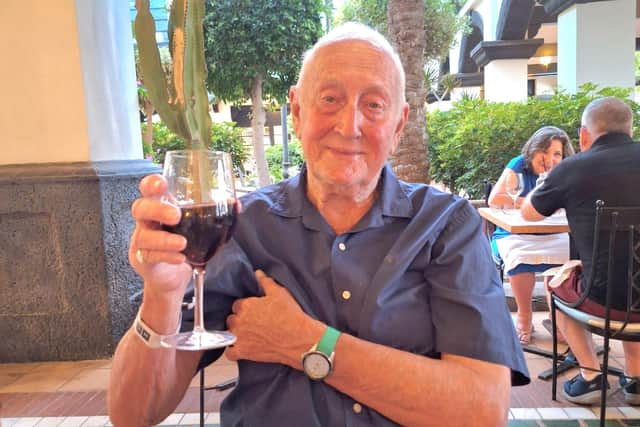
Today, I will be celebrating a landmark birthday with my close family, and even though I am doing so privately, I am privileged to record my recollections publicly in this venerable newspaper which itself celebrated a remarkable landmark birthday quite recently.
Having been born shortly after the outbreak of World War Two, I was brought up in the South Armagh village of Bessbrook at a time when Hitler’s troops were rampaging across Europe. The outlook was bleak, though I did not know this at the time as my family placed me in a drawer because no cot was available.

In 1945 I began my education in the local Public Elementary School with my lifelong friend Geoffrey Martin, the former high-ranking European official in Belfast, London and elsewhere.
It is hard to believe that we started school only a few months after Hitler committed suicide in his Berlin bunker, and when the monstrous Stalin continued obscene oppression behind the Iron Curtain.
How sad it is that a different Russian monster is imposing terror from his Kremlin citadel even today.
Our primary teacher James Darragh was totally fair in that he frequently slapped almost everyone in my class with a broken billiard cue, but I owe him much for hammering into me the basics of grammar and a love for the English language which has sustained me during a long and rich journalistic and writing career.
Children of my generation were fortunate that the 1947 Education Act opened for us a door to grammar school, and a pathway to university – provided we could pass the 11-Plus, then called the Qualifying.
Somehow I managed to succeed, even though my guardian beloved grandfather Thomas McCreary as well as my maternal family (like me) had no idea what that would lead to.
At 18 I left my native village, which taught me much about true cross-community life, and which had given me a basis of the Christian faith through the Presbyterian Church, which to my great regret has regressed into a right-wing rump which has drawn a swirling cloak of self-righteousness around itself, and is thereby alienating those people who long for the reassurance of a broad church.
When I came up to Queen’s it was a university of excellent teachers under the leadership of Sir Eric Ashby, one of the best vice-chancellors in its history.
Many years later I was also fortunate to serve as Queen’s first Information Director under another truly outstanding vice chancellor, Sir George Bain.
Queen’s taught me many things, including the ability to think for myself in the Honours School of Modern History, where I had world-class professors though I was too naïve to know this at the time.
At Queen’s I also had the good fortune to edit the student newspaper Gown which helped me to secure a staff job with the Belfast Telegraph under the editorship of the legendary Dr J E Sayers. Like my old primary school principal, Jack Sayers took no prisoners but I also owe him a great debt for opening a doorway for me into the world of newspapers and teaching me the finest principles of fair-minded and independent journalism.
In those years I worked with some colleagues who reached the highest positions in print and broadcasting, and I also recall really good journalists who worked for this newspaper including its onetime editor, the larger-than-life Cowan Watson.
In the mid-Sixties there was hope in the air, with the progressive unionism of Terence O’Neill and lots of inward investment, but all too soon it all fell apart, partly due to the outrageous bigotry of the Reverend Ian Paisley, who had much to answer for.
The Troubles hardened many of my generation of journalists into war correspondents, but tragically we were reporting a war largely between our own people.
I look back with immense sadness at some of the big stories I covered, including Bloody Friday, Bloody Sunday, the Enniskillen Cenotaph Bomb, and the Kingsmill massacre, and the heartbreak and pain of so many people.
In the midst of the darkness we looked for the light, and it came through the Good Friday Agreement, or so we thought. Things are much better now, and thankfully there are no longer the endless snakes of funeral corteges crossing every parish, but the political deadlock remains.
The only mantra is still Orange versus Green, and those who campaign for a united Ireland may find they are chasing a mirage. You cannot change a century and more of division on this island virtually overnight. We do not have enough politicians who have the courage and vision needed for our time. We too lack vision and courage.
Socially there have been many positive developments during my long lifetime.
The vast medical changes in health care have helped people live much longer, and some to the point where they spend their last days in care and nursing homes, perhaps in pain and distress. I don’t believe that the Assisted Dying Bill, which I call the Assisted Suicide Bill, is the answer. However, if I was in such a bad condition, I might be tempted to consider the possibility of an early escape, who knows?
Our world is now vastly richer compared to my early days, with a much wider choice of almost everything, but are we any happier?
There is also a great sense of entitlement, but much less of service for our neighbours in a secular world which seems to be losing its moral compass.
Someone once said that when people stop believing in God they will start believing in anything.
The current and terrifying international scene is more dangerous than in any period of my life, but yet we must cling on to hope because we still live in a beautiful world with so much to cherish.
Several decades ago, on another landmark birthday, my wife Hilary gave me a card with an inscription from the German philosopher Goethe which I still hold close to me: “Nothing should be prized more highly than the value of each day.”
You cannot ask for more than that, whatever age you are …
l Alf McCreary’s latest book Keeping the Faith is published by Messenger at £12.99