
William McKinley was third president to be assassinated but laid foundations for 'the American Century'
William McKinley’s second term as US president had scarcely begun when it came to a tragic end in September 1901.
On September 6 President McKinley was standing in a receiving line at the Pan-American Exposition at Buffalo, New York, when Leon Czolgosz, an anarchist, shot him twice with a revolver concealed in a handkerchief.
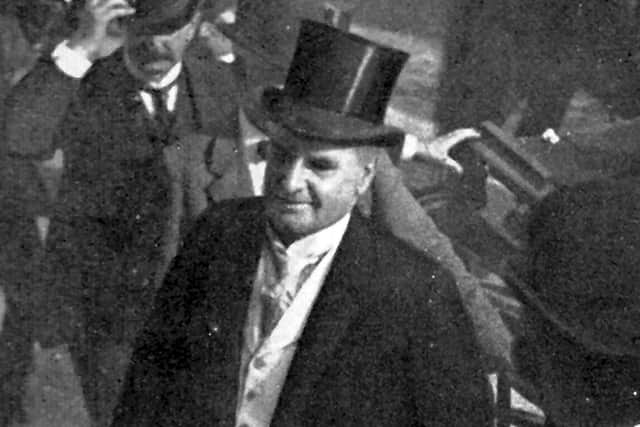

George Cortelyou, McKinley’s secretary, had warned him that he was needlessly exposing himself to danger but McKinley had replied, ‘No one would want to hurt me.’
One bullet was easily found and extracted but doctors were unable to locate the second bullet. Fearing that the search for the bullet might cause more harm than good, doctors decided to leave the bullet where it was.
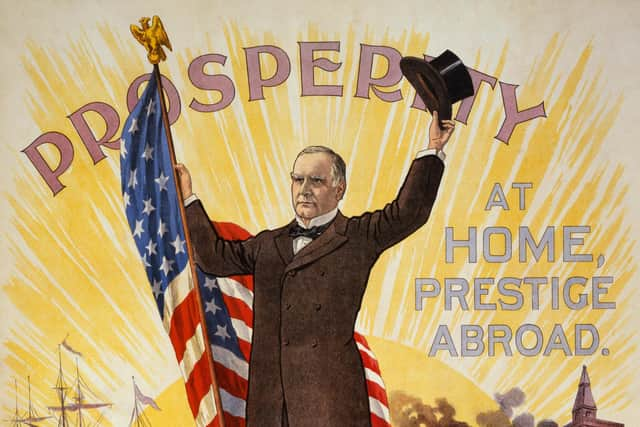
Initially there were real grounds for optimism because McKinley seemed to be recovering from his wounds but gangrene developed and he died on September 14 1901. A devout Methodist, his last words were: ‘It is God’s way; His will be done, not ours.’
McKinley was the third US president to have succumbed to an assassin’s bullet.
Donald J Trump is a great admirer of the 25th president whose great-grand-grandfather James McKinley had emigrated from Conagher, Co Antrim, in 1740s.
At his second inauguration Trump renamed North America’s highest mountain peak Mount McKinley, reversing President Obama's decision in 2015 to give the mountain its traditional indigenous name, Denali.
Trump admires McKinley for two reasons. First, because he presided over a period of territorial expansion and, secondly, because Trump believes McKinley ‘made our country rich through tariffs’ – not incidentally a view shared by economic historians.
Although accused of being a war lover, as a Methodist and a civil war veteran, McKinley was certainly no warmonger: ‘I shall not get into a war until I am sure that God and man approve. I have been through one war; I have seen the dead pile up; and I do not want to see another’. (McKinley saw action at Antietam, one of the bloodiest battles of the civil war and came under heavy fire when bringing rations to the men on the line.)
Nor, despite acquiring an American overseas empire, was he a natural imperialist. McKinley had originally declared that the annexation of the Philippines would be ‘an act of criminal aggression’. Clearly, he changed his mind but in doing so he was simply bowing to public opinion.
Joseph Cannon, a future Speaker of the House of Representatives, claimed McKinley kept his ear so close to the ground that it was ‘full of grasshoppers’. (The Spanish-American War demonstrated the growing importance of public opinion in American politics.)
Whereas McKinley managed to acquire Hawaii, Guam, Puerto Rico, the Philippines and Cuba as an informal colony, Trump, despite his declared intentions, has failed so far to absorb the Straits of Hormuz and Kharg Island, the Panama Canal, Greenland, Venezuela, Cuba, Canada and the Gaza Strip into his putative American empire.
McKinley laid the foundations of ‘the American Century’ whereas Trump seems to be presiding over its demise.
For most of his political career McKinley was an ardent protectionist and relished the nickname ‘the Napoleon of tariffs’.
His commitment to tariffs was familial rather than ideological. His father was in the pig iron business and ‘the duty on foreign iron had not been an abstract idea to an iron founder’s son but the source of bread and butter’.
The McKinley tariff of 1890 raised import duties from 41% to 52% and was electorally disastrous for the Republican Party. A Republican majority of seven in the House was overturned by a crushing Democratic majority of 147. McKinley even lost his own seat in Congress.
In 1870 the US economy and the British economy were the same size. By 1900 the GDP of the US was twice the size of the UK’s.
This fact owed nothing to tariffs. Even McKinley came to recognise this, realising that the US economy needed new markets for its exports rather than protectionism.
McKinley decided to reveal his radical new economic thinking in a speech at the Pan-American Exposition at Buffalo on September 5 1901. He explained: ‘Reciprocity is the natural outgrowth of our wonderful industrial development.’
Repudiating isolationism and protectionism, he proclaimed: ‘The period of exclusiveness is past. The expansion of our trade and commerce is the pressing problem.’
He continued: ‘Commercial wars are unprofitable. A policy of goodwill and friendly relations will prevent reprisals. Reciprocal treaties are in harmony with the spirit of the times, measures of retaliation are not.’
The speech was well received and greeted with enthusiasm and rapturous applause.
The next day Leon Czolgosz mortally wounded the president.
Trump’s insistence that the word tariff is ‘the most beautiful word in the dictionary’ strongly suggests that Trump never managed to complete reading any biography of McKinley.
McKinley left two legacies which Trump is unlikely to emulate.
In the presidential election of 1896, as Karl Rove, the Republican electoral strategist, has pointed out in his book ‘The triumph of William McKinley’, the 25th president laid the foundations of success for his party over an extended period. McKinley’s landslide victory established the Republicans as the dominant party for a generation. Except for the presidency of Woodrow Wilson (1913-21), Republicans monopolised the White House and dominated the Congress between 1896 and 1932.
Furthermore, McKinley raised America’s prestige and status in the world. Trump aspires to ‘Make America great again’ through his ‘America First’ trade and erratic foreign policies.
Instead, he has undermined America’s credibility and standing in the world and inadvertently enhanced and expanded China's relative global influence and soft power.
Trump’s hostility towards scientific research has weakened the US’s competitive position vis-à-vis China.
He has ceded long-term leadership to China in several critical industries of the future, including electric cars, wind turbines and batteries.
China also emerged victorious in Trump’s misjudged trade war with Beijing, the Chinese forcing him to back down.