
Hilary Benn hails the disputed notion of an 'all Ireland economy,' appearing to row back from a commitment to unionists
The new Labour government has hailed the all-Ireland economy, contradicting their Conservative predecessors – who said the all-island concept was exaggerated.
Hilary Benn said cross-border business was not only real but a success, putting himself at odds with the ex Tory government and threatening a concession they gave unionists.
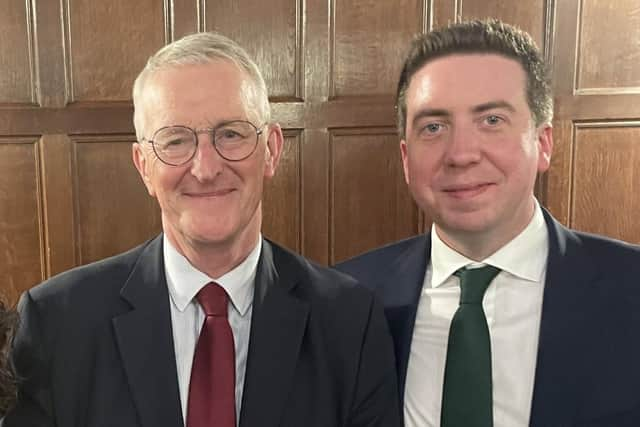

In a speech on Saturday that was full of reassurance to nationalist Ireland, the NI secretary Mr Benn told the British-Irish Association in Oxford that he applauded Micheál Martin, the former Taoiseach who was in the audience, for “taking forward the Shared Island Programme”.
Then he added: “And when it comes to the all-island economy, and I know this is up for some debate, my feelings are very simple, it is a fact it is a success. And I don’t quite understand why there should be an argument about somehow denying its existence when so many businesses and livelihoods are sustained by it: the all-island dairy industry, big multinationals, like Lidl, McDonalds, Coca-Cola and so many small and medium-sized businesses which operate on an all-island basis.”
This suggests a retreat from the recent Tory government’s position, which disputed the all-island economy, and which in its deal with the DUP committed to a “complete repeal” of statutory duties relating to it.
Mr Benn’s comments put in doubt a commitment in Rishi Sunak’s Safeguarding the Union deal for the DUP, an agreement that the new government never seems to cite.
Among the reassurances for unionists, that deal said: “The government recognises that one of the key concerns for unionists in Northern Ireland within the 2017 UK-EU Joint Report is related to the promotion of the political concept of the 'all-island economy.' Whilst access to the EU market has broad support amongst business and consumers, the creation of a new political construct of the 'all-island economy' is clearly more divisive in nature and has been rejected by the current government.
"The Windsor Framework decisively moved away from this concept, and indeed envisages growing divergence across the international land border, with labelling and market surveillance used to seek to avoid products being placed illegally on the market in Ireland. However, the government accepts that there are concerns we have not yet gone far enough to decisively remove all the legal ramifications of the acceptance in 2017 by the then UK government of the need to protect the 'all-island economy' in relation to goods.
"Specifically we agree that it is unacceptable that ministers still have a legal duty to have regard to protecting the 'all-island economy.' This applies to all Statutory Instruments relating to the Windsor Framework and therefore could continue to have a long-term distorting legal effect that detracts from our actual priority to protect Northern Ireland's place in the UK internal market and customs territory.”
On Saturday Mr Benn did say that “this government will ensure the smooth flow of goods within the UK internal market”. He also said that “while being strong supporters of the Union, this government and this secretary of state see no contradiction in also being supporters of North-South cooperation”.
But the speech, as we reported on Saturday, was far more full of reassurance to nationalists than unionists, including an implied joint approach forward with Dublin if Stormont falls again.
The audience included Sinn Fein’s first minister Michelle O’Neill, the DUP deputy first minister Emma Little Pengelly, and the new Labour MP Liam Conlon, who is son of the controversial advisor to Keir Starmer, Sue Gray, who wants Casement GAA built.