
Northern Ireland Troubles Bill passes second reading in the face of unionist and Tory opposition

The government’s Northern Ireland Troubles Bill has passed its second reading in the House of Commons.
It was opposed by unionist politicians from Northern Ireland and the Tory Party, but with Labour holding 405 of 650 seats, it comfortably sailed through to the next phase, the committee stage, where MPs will try to amend it.
An amendment aimed at halting the bill failed by 165 votes to 327, then the bill itself was voted through its second reading by 320 votes to 105 tonight.
It is part of a package of measures, agreed with the Irish government, on handling the legacy of the conflict.

It involves, among other things, setting up a new Legacy Commission to investigate historic cases, re-opening Troubles inquests, and re-permitting civil claims against the state.
It largely replaces the ex-Tory government’s Legacy Bill, which effectively ended all Troubles investigations and gave a conditional amnesty to perpetrators who were judged to have come clean in their accounts of their crimes.
Opponents say it effectively re-starts a process of legal action that unfairly focuses on the state.
Tory MP Mark Francois, the shadow defence minister, called it “a virtually friendless bill,” pointing to a string of veterans groups which had raised concerns about it.
"I conclude there is no other country on Earth that would treat its own brave veterans in this way – none,” he told MPs.
"This is a truly wretched bill supported by Sinn Fein, but opposed not just by these benches, but also by thousands of veterans…
"I say to all of those veterans tonight that if we get the chance, we will do whatever it takes to rescind Labour's bill and to stand by them, just as we sought to do with our original Legacy Act of 2023.”
Speaking in its favour was Claire Hanna, leader of the SDLP.
"Many in this house believe in the rule of law and in the equality of every person in front of the law,” she said.
"Between 30,000 and 40,000 people were properly convicted of paramilitary offences, and 300,000 soldiers served under Operation Banner.
"Can the shadow Secretary of State outline how many of those have been in court?
"The answer is 20.”
Earlier the Northern Ireland Secretary told MPs that a single soldier had been convicted of a Troubles-related crime since 1998, and had got a suspended sentence.
Former Tory leader Sir Iain Duncan Smith, who was posted to Northern Ireland while a soldier, responded to Ms Hanna’s comment by saying it “suggested this is a numbers game based on the numbers who were out there in Northern Ireland”.
He went on: “With respect, I actually served out there, and I can tell you something about this.
"The reality is that the British Army was sent to hold the peace against terrorists who set out to kill people deliberately for their own political ends.”
He asked “is it not wrong to equate the two”?
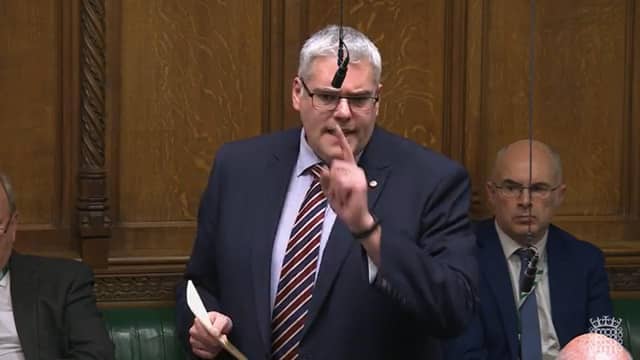
DUP leader Gavin Robinson had denounced the bill in the Commons, and after he spoke he released a statement saying: “This bill is built on foundations laid in 1998 when justice was corrupted.
"The terrorists convicted were released and the terrorists on the run were given pardons.
"You can’t build a house on sand…
"The fact that this bill outlaws anyone serving in the police or military from being appointable as one of the directors [of the new Legacy Commission] is an insult to those who served in the RUC and PSNI.
"It is outrageous and not legally sustainable. It is a sop to the Irish government.
"Rather than stand up for the PSNI or the RUC, this Secretary of State has sullied himself by jumping to the Irish government’s tune.”
You can read more from him and others in the debate, as well as the Secretary of State’s defence of the bill, here: