
Owen Polley: Sea border advocates never cared about NI’s economy
The Trump tariff fiasco underlined two important lessons for Northern Ireland that were already obvious to anyone who paid close attention.
Firstly, our prosperity is dependent on this province being an inseparable part of the UK and it will remain so for the foreseeable future. The British economy is by far our biggest source of sales, purchases and protection.

Secondly, the Windsor Framework is a growing threat to jobs and wealth. It kept us aligned with the EU to the detriment of our place in the British market, and the more thoroughly it is implemented the more serious the damage becomes.
From these two basic lessons, we can draw a third, related conclusion.
The Irish Sea border’s supporters never really cared primarily about Northern Ireland’s economic success. In the case of nationalists, they were committed to destroying our links with the rest of the UK, so that they could achieve their goal of a separatist Irish state. For them, the Irish Sea border is intended to realign business here with Dublin.
In the case of Alliance and other ‘progressives’, they claimed to be less ideological than unionists or nationalists, but actually their unthinking loyalty was to Brussels. They are prepared to risk pain for businesses and constitutional limbo for Northern Ireland, to salvage as much EU in Northern Ireland as possible.
This is important because unionists have opposed the framework openly on all kinds of grounds – some of them economic, but others emphasising our place in the UK, immigration controls or the integrity of the British legal system. In response, they have been ridiculed and accused of putting selfish concerns above prosperity.
At the same time, the lie was spread that the sea border’s supporters were pragmatic and would look out for this province’s economic interests.
This process has been helped by businesses’ reluctance to express their objections to the framework frankly, because they do not want to be seen to take an overtly political stance.
I’ve seen and heard numerous accounts of stormy meetings with government officials behind closed doors, and executives who felt ill with anxiety about the sea border. Likewise, I’ve worked my way through trails of correspondence expressing frustration, fear and even despair, among representatives in important industries.
Only a few have spoken out about this openly.
The consensus is that it is best to work quietly with officials, even if that rarely seems to produce satisfactory outcomes. Taking a ‘partisan’ position could alienate customers or clients.
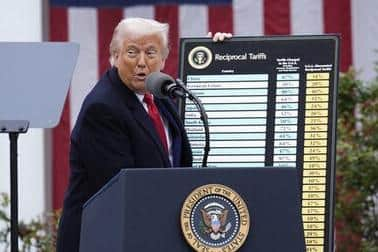
No doubt, many firms are even more worried after Trump’s announcement last week. The United States imposed a 10% tariff (or tax) on goods it imports from the UK and a 20% tariff on EU goods.
To justify this, President Trump claimed that the rest of the world was taking advantage of America in global trade.
Many countries or blocs, including the EU, imposed relatively high tariffs on American goods, but were taxed less to sell their products to the US. Some markets, like China, produced products for absurdly low prices, while paying their workers less and having lax employment laws.
Trump has bundled these things together to make the case that his country was treated badly. He implied that other nations grew rich thanks to America’s wealth and generosity, while it became relatively poorer.
The full consequences for Northern Ireland are not yet clear, but they are starting to emerge.
Products that our businesses sell to the US will mostly be subjected to the lower 10% tariff, unless they are affected by complex ‘rules of origin’. Meanwhile, their counterparts in the EU (including the Republic) face 20% levies.
The biggest problem is that the EU is likely to retaliate by imposing higher tariffs than the UK on US imports.
Northern Ireland is effectively in Brussels’ single market for goods and customs union, so our companies would have to pay this higher rate for American products, even if the rest of the UK paid less.
In theory, they could claim back the difference, if they proved the goods were staying in Northern Ireland or Great Britain. However, this process is complicated and, for many companies, it is difficult to provide the evidence the EU requires to show products are not ‘at risk’ of entering its market.
As a result, our firms would inevitably become less competitive and consumers would face extra costs.
In response to this emerging crisis, unionists called on the government to protect Northern Ireland and criticised the Windsor Framework as the source of our specific problems.
In contrast, Alliance shrieked about standing ‘firm with our allies’ (for which you can read the EU) and ‘resetting our relationship with our European neighbours’.
Its message was, never mind that the rest of the UK has been spared the worst effects of Trump’s tariffs, our real friends are in Brussels.
Meanwhile, Sinn Fein’s Michelle O’Neill blethered about protecting the ‘all-island economy’ and ‘everyone who calls our island home’.
These responses were equally contemptible, but they were exactly what we should have expected.
Almost inevitably, as well, the sea border’s supporters will soon blame these problems on Brexit.
It will not trouble them that the rest of the UK is being spared the full 20% tariff only because it left the EU. And they will not acknowledge that we are treated differently, only because Northern Ireland was never allowed to leave with the rest of the country.