
Completion of the two year restoration of a 1946 Ferguson TE20
With the restoration of my 1946 Ferguson TE20 tractor that was once owned by John Malet Chambers now finally complete just in time for the tractor’s 80th birthday I thought it would be nice to give a little update with a few pictures and a clip of it running during a wet day last week.
Throughout the almost two year restoration I have tried to retain as many original parts as possible that came with the tractor at purchase on the 5th of November, 2024. This may have reduced restoration part costs but was time consuming for example the front axle carrier that was badly corroded and needed to be welded up as did the axle support beams that had cracked along the welds and required welding. However it did add to the originally of the tractor to keep it as close to how it would have been when owned by John Malet Chambers.
When I look at Ferguson TE20 serial number 1, the first production Ferguson TE20 that was assembled on Saturday 6th July, 1946 and that is now displayed by AGCO who owns the Massey Ferguson brand at the Agrispace Museum in France I was not going to leave Mr. Chambers tractor disfigured in the same way by so many new and incorrect parts as sadly is the case with Ferguson TE20 number 1.
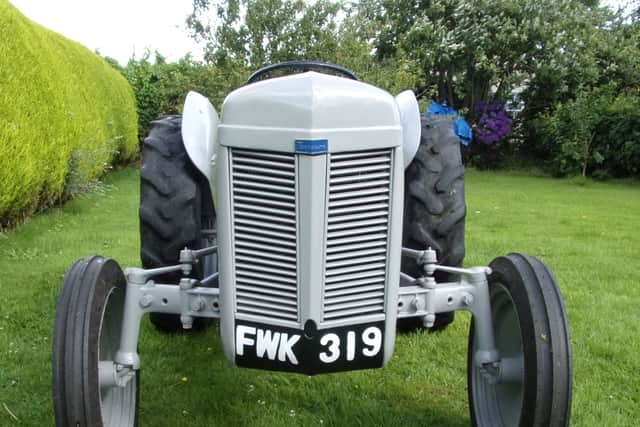

At one stage someone had started to be clean down the tractor for painting, especially at the front although it had a little brush of grey primmer applied and this made the corrosion worse. This was probably around 1985 when the tractor was put into storage. It was very lucky indeed that the back of the tractor was not cleaned down or repainted because after treating the whole tractor in oil making disassembly easier you could clearly read the original Coventry vehicle registration FWK 319 that was issued to the Standard Motor Company at Banner Lane Coventry. I could also clearly see the original grey paint and used it to match it exactly to the colour the tractor has been repainted in, a light battleship grey.
I like the tractor’s registration FWK followed by the number 3 as it can be considered short for framework three and as such describes the Ferguson System three point hydraulic linkage perfectly and also as a new farming framework to attach implements. Perhaps Mr. Chambers would have thought of it in a similar manner and so selected the registration for his tractor.
Obtaining original components for the tractor was a nightmare because of the internal Irish Sea border that means so many suppliers in for example England are no longer willing to send parts to Northern Ireland or if they will they demand excessive delivery charges to cover the red tape demanded by the EU as Northern Ireland is treated as an EU territory –
I want to take this opportunity to thank family and friends for helping me with parts. A relative gave me a front Ferguson badge that had once belonged to my uncle Dennis Kelly, the man who helped get me started in my lifelong interest in vintage tractors. A cousin got me a few small parts like the correct ignition light and mudguard stays. Another cousin who is good with a metal lathe repaired the very rare original but fragile steering wheel fitted to only a few hundred tractors and that was so easy to damage it was quickly superseded by the more common later versions. A member of the Derg Valley Club gave me a carburettor that I restored and other parts. A neighbour got me a set of Ferguson rear wheels and tyres that I was able to exchange for the correct rear wheels with the valve neck on the inside. A new manifold was obtained in the USA, this turned out to be the most expensive part for the restoration at £242 Pounds including shipping, and although not quite right it is very close to the original type. I hand fabricated a new carburettor to manifold pipe and fitted it. Refitted the Rockwell oil pressure gauge that I found placed in the fuel tank for safe keeping! I believe it to be original and is like the one shown in pictures of the tractor. New mudguard skins were fitted to the mudguard brackets. An exhaust silencer shield was fabricated. New front tyres and tubes fitted. The bonnet was not in bad condition although it needed work, it still had the dent in the same place as in the publicity pictures.
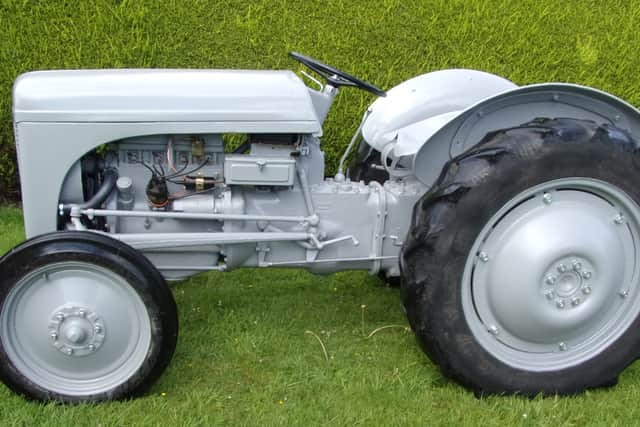
Overall I was amazed at the condition the tractor was mechanically in with little indication of wear. Even the lift arms were tight and unworn. As was the gear lever, clutch and brake pedals. It was quite clear it had an easy life which helped to illustrate how special this little grey Ferguson is. I suspect this is because it having spent a while in the Ferguson training school before being shipped to Northern Ireland by Mr. Chambers.
During the restoration I had to replace many of the nuts as they had been rounded, most likely by the constant disassembly and rebuilding from the tractor’s days at the training school. I was very lucky to obtain new old stock front and rear wheel nuts.
One last issue that arose after completing the painting and reassembly, on starting the tractor I discovered a very serious oil leak at the sump of the engine. This resulted in it needing to be disassembled and have a new gasket fitted that thankfully stopped the leak.
The last few months of the restoration involved a lot of cleaning by wire brush and painting. I know the quality of my painting is not the best but I believe it adds to the authenticity of the tractor, after all when the tractors were assembled each part or casting was dipped first in red primer and then gloss paint so components have runs in the paint – an example of such original paint runs or drips I have left on the steering box. After assembly in the factory at the end of the production line the whole tractor was treated to a blast of battleship light grey paint by spray gun that had very little gloss and resulted in overspray for example on the tyres.
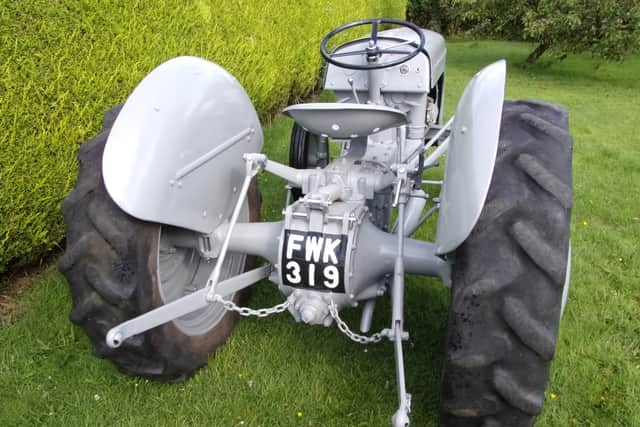
Anyone that has a 1946 Ferguson TE20 (Tractor England 20HP) know they have a very special and sought after tractor because of the over half a million Ferguson TE20 tractors built from 1946 to 1956 only 315 were assembled in 1946 due to casting difficulties, material, component sourcing problems and training of staff by the Standard Motor Company of Coventry to build them for Harry Ferguson Ltd.
This is true of my tractor, but I am much more honoured and privileged to be the guardian of this very special part of Ferguson farm tractor history, and to think this very tractor could have been broken for parts and lost to history just a matter of only a few years ago!
With the restoration now complete it will be a lasting tribute to one of my personal favourite innovators in the Ferguson tractor story, John Malet Chambers, Harry Ferguson’s chief engineer. The man Harry Ferguson tasked with working with the Standard Motor Company to get the Ferguson TE20 into production 80 years ago.
Stevan Patterson, Castlederg Co. Tyrone