
Mourne Mountains volunteer on wildfires: 'It's only luck no-one has been hurt - and you can't stay lucky indefinitely'
A mountain rescue volunteer whose charity has been helping firefighters handle the blazes in the Mournes says it is mere luck no-one has been hurt yet.
But Neville Watson, one of the co-ordinators of the Mourne Mountains Rescue Team (and principal of All Children’s Integrated Primary School in Newcastle), added that luck does not last “indefinitely”.
He also described the damage to wildlife from the blazes, most of which he believes begin deliberately.
He was speaking as the fire brigade battled a blaze on Chimney Rock Mountain in the east of the Mournes today, involving about 45 firefighters at its height, as well as one off Sandbank Road in the west of the Mournes which has been going on since Sunday.
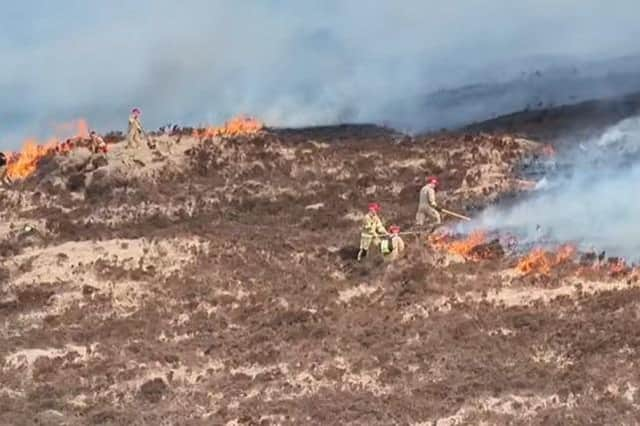

The PSNI tonight issued a plea to the public to stay away from “the Mournes area in general”.
Sergeant Kenny Gracey said: “I can’t stress highly enough how important it is for visitors to stay clear of the Mournes area until these fires are dealt with.
"Just being in the area can put individuals at risk, impede emergency services in their work and can also tie up crucial resources that may be needed elsewhere.
"We appreciate your patience and understanding at this time.”
Yesterday, the fire brigade had declared that a fire had been put out in the Ballagh Road area of the mountains.
It had begun on Saturday, involved 80 firefighters at its peak, and is being treated as deliberate.
‘HUMAN BEHAVIOUR THE ROOT’:
Mr Watson said four volunteers from his roughly 35-strong charity were in the Mournes on Saturday to help firefighters, while two were up on Sunday.
They were helping ferry firefighters as close as possible to the blaze as possible, went around homes in the area warning residents they may have to leave, and evacuated a campsite.
He believes Saturday was the first wildfire of the season in the area.
Mr Watson has worked with the charity for 15 years, and said wildfires have been a feature for about the last 10 of those.
Asked if they have been becoming more frequent, he said he has no statistics but it “certainly feels like that”.
He said climate change is often a factor cited, but that “nearly all” are started deliberately so human behaviour is “at the root of it all” – whether the fires are started to manage the land, by campers barbecuing, or by some malicious “thrill-seeker”.
IMPACT ON WILDLIFE:
He said: “We spend a lot of time in the mountains, and at this time of year you’ve got lots of birds who nest on the ground.
"When you look at the hectares and hectares [of fires] that have occurred here, what you get is burnt heather, burnt grassland.
"It can burn down into the soil and the turf underneath that.
"So any nest in that area of hectares and hectares is going to be destroyed.
"You’re potentially looking at young birds being wiped out, parent birds potentially being wiped out too, amphibious animals like frogs and lizards, if they can’t get away, wiped out as well.
"Most of these animals are contributing in some way to how our whole ecosystem functions.
"Nature will recover, and will outlast us, but the impact there, you’re talking about potentially years before that damage is undone.”
He went on to add that “so far” the fires have not killed anyone or burned down their houses, but “it seems almost as if it’s luck at the minute”.
"But you can’t get lucky every year, indefinitely.
"That’d be our big concern: if this pattern continues as we’ve seen, it seems like sooner or later we’re going to be talking about some real impacts on humans.”
Apart from anything else, the fires take firefighters away from their duties elsewhere, so “that is a potential inadvertent human impact; maybe that’s already happened – who knows?”